<?xml version="1.0" encoding="utf-8"?>
<feed xmlns="http://www.w3.org/2005/Atom">
  <title>Applied Divinity Studies</title>
  
  <subtitle>applieddivinitystudies@gmail.com</subtitle>
  <link href="https://applieddivinitystudies.com/atom.xml" rel="self"/>
  
  <link href="https://applieddivinitystudies.com/"/>
  <updated>2026-07-02T17:18:52.726Z</updated>
  <id>https://applieddivinitystudies.com/</id>
  
  <author>
    <name>John Doe</name>
    
  </author>
  
  <generator uri="https://hexo.io/">Hexo</generator>
  
  <entry>
    <title>Peter Thiel and the Antichrist</title>
    <link href="https://applieddivinitystudies.com/antichrist/"/>
    <id>https://applieddivinitystudies.com/antichrist/</id>
    <published>2025-10-27T00:00:00.000Z</published>
    <updated>2026-07-02T17:18:52.726Z</updated>
    
    <content type="html"><![CDATA[<p>If someone says “because Jesus is real, we should overthrow the US government”, they would get dismissed as a religious nut. That sounds bad, but it is strongly preferable to the alternative where they only say the second half of the sentence.</p><p>Peter Thiel’s recent Antichrist lectures have attracted a lot of attention, nearly none of it related to the “second half” of his sentence. Peter is a Straussian, so this is not a coincidence. [1]</p><p>It is nothing new for an intellectual’s ideological opponents to strawman his views. [2] What I find interesting is how little even his proponents seem to care about what is actually being said. [3] This could be fine if Peter’s recent lectures were a kind of call to arms, and this was now merely a matter of true believers executing on a vision. But you don’t spend four hours lecturing on an idea that’s simple or easy.</p><p>And in fact, Peter’s tone is more troubled and contemplative than triumphant, and most of what he poses is closer to a problem than to a solution. Perhaps we can say that Armageddon is preferable to Antichrist, but both are obviously just so so bad. And that would be clear if his “fans” weren’t busy trying to pick sides. [4]</p><p>So what are the questions? I see basically two tensions, one you could think of as “Thiel v1” and the other as v2, but they’re connected to the same undercurrent:</p><ol><li>Without a monopoly, you are constrained by competition and can’t really be free. But with a monopoly, you have the freedom to become arbitrarily dysfunctional. An immortal being can become infinitely decrepit.</li><li>Since technology can progress, it may eventually become powerful enough to kill everyone. But a force capable of regulating this technology would be at least as powerful [5], and stagnation comes with its own dangers.</li></ol><p>I see these are more like “themes” than paradoxes, with many “middle ways” through. But finding those paths in any particular instance remains up to us. Thiel sees our trajectory through history as undetermined, and our choices as consequential. Ignoring these issues is thus a tempting way to shirk responsibility, but it is not a viable path forward.</p><p>In these matters, as in all others, we do have a choice. And that is the far scarier reality to contemplate.</p><hr><p>[1] As <a href="https://www.applieddivinitystudies.com/exegesis/">I wrote earlier</a>:</p><blockquote><p>the truth is more mundane. It turns out that the art of Straussian writing isn’t difficult at all… you can espouse over and over again in perfectly literal terms… and still no one will listen.</p></blockquote><p>Or from <a href="https://nadia.xyz/ideas">Nadia</a> years ago:</p><blockquote><p>Ideas are fascinators that sparkle and dangle in front of the creator, distracting an eager audience from the person behind the curtain.</p></blockquote><p>Peter is a billionaire and lives in America, and it would be reasonable to ask why he needs any kind of protection. We are reportedly “post” cancel culture, and Peter has said enough to get canceled 10 times over anyway, so why hedge or distract?</p><p>I don’t think there’s anything complex happening here. Peter is a Christian and a Girardian and is just super sensitive to persecution. Or more generously, he’s attuned to the way that things can always take a sudden turn south.</p><p>For what it’s worth, this is my answer to most questions about Peter. His beliefs are basically what’s on the tin. It’s just that you actually have to read the tin. This is why I am unlikely to write any kind of “Peter Thiel Exegesis”. It would just be a list of quotes taken literally and in context, which at the limit is just called reading the source material.</p><p>[2] Ben West on <a href="https://forum.effectivealtruism.org/posts/hGwAohPbwCrDT5ynY/ea-as-antichrist-understanding-peter-thiel">EA Forum</a> somewhat attempts to engage with Peter’s ideas, but then jumps into some pretty serious errors.</p><p>Part of this is just Ben wanting Peter’s claims to be about EA specifically, rather than merely in the abstract. It is always fun to be named, even as an enemy.</p><p>The more substantial mistake Ben makes is in thinking that Peter sees AI as the only way out of stagnation. Quoting his NYT interview:</p><blockquote><p>If you don’t have A.I., wow, there’s just nothing going on.</p></blockquote><p>But Peter means this as a criticism, not an endorsement. I.e. That it’s a really bad state of affairs that without AI there seems to be nothing else going on, and we should instead try to move towards a more dynamic world where there are other things also moving forward.</p><p>More explicitly, here’s Thiel from his conversation with Tyler on <a href="https://conversationswithtyler.com/episodes/peter-thiel-political-theology/">Political Theology</a>:</p><blockquote><p>Maybe the premise of your question is what I’d challenge. It’s, why is AI going to be the only technology that matters? If we say there’s only this one big technology that’s going to be developed, and it is going to dominate everything else, that’s already, in a way, conceding a version of the centralization point. So, yes, if we say that it’s all around the next generation of large language models, nothing else matters, then you’ve probably collapsed it to a small number of players. And that’s a future that I find somewhat uncomfortably centralizing, probably.</p></blockquote><blockquote><p>The definition of technology — in the 1960s, technology meant computers, but it also meant new medicines, and it meant spaceships and supersonic planes and the Green Revolution in agriculture. Then, at some point, technology today just means IT. Maybe we’re going to narrow it even further to AI. And it seems to be that this narrowing is a manifestation of the centralizing stagnation that we should be trying to get out of.</p></blockquote><p>[3] One possible explanation is that Thiel’s supporters are merely respecting his privacy given the invite-only nature of the recent SF events. But other lectures on the same topic were given publicly and have been available online going back a year.</p><p>For that matter, I note that it is only after the most recent lectures that Thiel’s critics have really gotten excited about the whole Antichrist thing. When he spoke openly, this was not news. The news is merely about the fact of the event rather than the content itself.</p><p>[4] On <a href="https://www.google.com/search?q=%22Peter+thiel%22+%22charybdis%22&amp;sca_esv=ee794735903e3348&amp;sxsrf=AE3TifMrrlveWylXfHJxc0rw8vrsrbHtUQ%3A1761596379150&amp;ei=29P_aJ7fCNr00PEPloqSmAg&amp;ved=0ahUKEwjeuKrzmcWQAxVaOjQIHRaFBIMQ4dUDCBE&amp;uact=5&amp;oq=%22Peter+thiel%22+%22charybdis%22&amp;gs_lp=Egxnd3Mtd2l6LXNlcnAiGSJQZXRlciB0aGllbCIgImNoYXJ5YmRpcyIyBRAhGKsCMgUQIRirAkjlHVDFCFj4HHABeAGQAQCYAZ4BoAGuEKoBBDEuMTW4AQPIAQD4AQGYAgegAqoGwgIKEAAYsAMY1gQYR8ICDRAAGIAEGLADGEMYigXCAg4QABiwAxjkAhjWBNgBAcICExAuGIAEGLADGEMYyAMYigXYAQHCAgoQIxiABBgnGIoFwgINEC4YgAQYsQMYQxiKBcICBRAAGIAEwgIKEAAYgAQYQxiKBcICBhAAGAcYHsICHBAuGIAEGLEDGEMYigUYlwUY3AQY3gQY4ATYAQHCAgoQLhiABBhDGIoFwgIIEAAYogQYiQXCAgUQABjvBcICCBAAGIAEGKIEmAMAiAYBkAYTugYGCAEQARgJkgcDMS42oAeTRLIHAzAuNrgHpQbCBwcwLjEuNS4xyAci&amp;sclient=gws-wiz-serp">several occasions</a>, Thiel has evoked the image of a “Scylla of all these existential risks and the Charybdis of this political totalitarian catastrophe.” And while he’s clearly anti-Charbydis, it would be a huge mistake to frame him as pro-Scylla.</p><p><a href="https://www.youtube.com/watch?v=fQ4rc7npiXQ">One of his talks</a> carried the notable title “'Anti-Anti-Anti-Anti Classical Liberalism”, highlighting the extent to which he does not see a simple straightforward solution, merely objections to objections. Or from from his <a href="https://conversationswithtyler.com/episodes/peter-thiel-political-theology/">conversation with Tyler</a>:</p><blockquote><p>it’s not a pro-tech argument — this is sort of an anti-anti-tech argument — is that if we, again, talk about all these existential risks today … one other existential risk is a one-world totalitarian government.</p></blockquote><p>Or just explicitly and object level from the same interview:</p><blockquote><p>There are apocalyptic fears around AI that I think deserve to be taken seriously.</p></blockquote><p>[5] That this is clearly not true in general only somewhat diminishes the importance of the theme. And in fact, figuring out how to make it even less true feels to me one of the most promising resolutions.</p>]]></content>


    <summary type="html">&lt;p&gt;If someone says “because Jesus is real, we should overthrow the US government”, they would get dismissed as a religious nut. That sounds </summary>


  </entry>
  
  <entry>
    <title>Book Review: Nadia&#39;s Antimemetics</title>
    <link href="https://applieddivinitystudies.com/antimemetics/"/>
    <id>https://applieddivinitystudies.com/antimemetics/</id>
    <published>2025-05-10T00:00:00.000Z</published>
    <updated>2026-07-02T17:18:52.734Z</updated>
    
    <content type="html"><![CDATA[<p>Antimemetics is the study of ideas that resist spreading [0]. Ideas which are the opposite of memes. Rather than going viral, they go dark. Some antimemes are trivial (you can’t remember your friend’s license plate number), some very serious (the obscene prevalence of sexual assault in (not just) Hollywood that went largely unreported until the dam broke).</p><p>Faced with these unknown unknowns, the obvious responses are to either meet the challenge with vigilance or ignore it in resignation.</p><p>Nadia’s new book [1], <em><a href="https://darkforest.metalabel.com/antimemetics?variantId=1">Antimemetics</a></em>, takes neither approach. It is not a rallying cry to win, nor a panic about the danger that lie ahead. Nadia’s <em>Antimemetics</em> is merely post-war. We have, in Nadia’s view, already forgotten so much. The core of Antimemetics is an attempt to even acknowledge the loss, to take the time to count the bodies, and ask where we go from here.</p><hr><p>Of course, the antimemes you even know about are the ones weak enough to be discovered. Some antimemes are so strong they cannot even be looked at directly. <a href="https://en.wikipedia.org/wiki/The_Funniest_Joke_in_the_World">Monty Python</a> gives us one example:</p><blockquote><p>In a few moments, he will have written the funniest joke in the world, and as a consequence he will die laughing… It was obvious that this joke was lethal, no one could read it and live</p></blockquote><p>In the skit, the joke gets contained, translated, and then weaponized for use against the Nazis. This is possible only because the joke was written down. Were it simply effective upon being conceived of, and the would-be author killed on the spot, the cause of death would be left a mystery. The joke, even the existence of the joke, would remain forever unknown.</p><p>Infohazards are another kind of strong antimeme, this time on a civilizational scale. If there were a way to, as<a href="https://nickbostrom.com/papers/vulnerable.pdf">  Nick Bostrom describes</a>, create nuclear weapons at trivial cost and complexity, you would simply never know. A civilization that came across this technology would be left with only two options: successful containment, or rapid extinction.</p><p>This is the intriguing, funny, and very dark nature of antimemetics. The idea originated as a sci-fi story, has the flavor of a conspiracy theory, and yes, the antimemes are<a href="https://knowyourmeme.com/memes/is-x-in-the-room-with-us-right-now">  in the room with us now</a>.</p><hr><p>Antimemes themselves resist spreading, but even as a concept, antimemetics can be difficult to analyze directly. Nadia spends a lot of time talking around the issue instead.</p><p>And so <em>Antimemetics</em> is ostensibly about antimemes, but really it’s mostly about the social dynamics and the death of the open web. [4]</p><p><em>Antimemetics</em> comes from this soil: the internet has changed, a certain version of it is dying, we’ve retreated into bunkers called group chats, safe and curated spaces. We’re setting an expiration date on our content. Doing more over voice. Doing more privately. More in subcultures and social scenes are in fact designed not to “take off”.</p><p>And it bears these fruits: a desire to take note of what was lost, or at the very least acknowledge that there was loss at all. That the mode we are in does constitute a shift, has happened, and is happening to other people too.</p><p>The new post-public age is both cozy and terrifying.</p><p>Cozy, because we live increasingly in insular bubbles with gatekeepers and curators.[5] And terrifying of course, because, how fucked up does the outside world have to be for you to live this way?</p><p>Imagine taking a teaching job at a high school, only to find that kids kept their entire personalities hidden. I’ll show you mine if you show me yours. Even without seeing it directly, you could immediately infer a culture of bullying, fear, insecurity, etc. [6]</p><p>When I first read Nadia’s blog I refused to read anything else for a month. I didn’t want to be distracted. I had taken on the attitude of vigilance. There is something here. I don’t want to lose it. I have got to be very careful. If I forget I may never remember again. I must hold on tightly.</p><hr><p>Though <em>Antimemetics</em> is a new book, Nadia’s interests/concerns in the way the web is “going dark” have been around for a while. From<a href="https://nayafia.substack.com/p/im-back-sort-of">  her newsletter in 2021</a>:</p><blockquote><p>The edgiest ideas are no longer being published for public consumption, which is the next logical outcome of both a hostile public environment and finding your 1000 true fans. Maybe everyone just writes for their own tribes now, but what’s left is a void of writing that’s changing our public narrative, filled instead with memelords leering from dark alleyways and snake-oil salesmen spouting platitudes in abandoned town squares.</p></blockquote><p>I don’t know that that’s bad, necessarily. The notion of a unified public dialogue isn’t guaranteed to every generation. It’s just harder to see where society goes from here—how progress gets made—when we’re all stuck talking to ourselves.</p><p>What’s changed since 2021 is that she now provides an answer, if not in the content then at least in the contours.</p><p>Nadia’s <em>Antimemetics</em> was inspired by the sci-fi novel <em><a href="https://qntm.org/scp">There is No Antimemetics Division</a></em>, which was <a href="https://scp-wiki.wikidot.com/antimemetics-division-hub">originally published</a> on a <a href="https://scp-wiki.wikidot.com/">collaborative alternate-reality</a> wiki-style foundation about an organization dedicated to protecting humanity from <a href="https://scp-wiki.wikidot.com/about-the-scp-foundation">eldritch horrors</a>. Her book is being published by <a href="https://darkforest.metalabel.com/">The Dark Forest Collective</a> [7], a group of friends instantiated as a “label” (channel? producer?) on <a href="https://www.metalabel.com/">Metalabel</a> [8], a “release platform for creative work”.</p><p>Peter Thiel’s Zero to One lays out two distinct forms of progress:</p><ol><li>Developing new things (vertical progress, or innovation)</li><li>Spreading those new things (horizontal progress, or globalization)</li></ol><p>These mechanisms are synergistic, but also at odds with each other. If everyone adopts the current best practice, we risk crowding out new experiments. Consider a small country that gets “invaded” by Starbucks, and doesn’t get a chance to develop local coffee culture. In some ways this is good, and shows the system working as intended. Starbucks has created a fantastic product, they’ve heavily optimized it, those benefits should be spread across as many people as possible. On the other hand, these “best practices” have to come from somewhere, and spreading them too widely carries the risk of premature optimization.</p><p><a href="https://www.dwarkesh.com/p/tony-blair">Dwarkesh</a> interviewing Tony Blair on his work advising world leaders:</p><blockquote><p>For any one leader you’re probably giving very sensible advice for their country. It’s a positive expected value. To the extent that limits variance and experimentation across countries in different ways to govern or different policies, are we losing the ability to discover a new Singapore?</p></blockquote><p>It’s tempting to homogenize in order to spread good ideas, but we need to maintain enough heterogeneity to keep pockets of innovation alive so that there are new and even better ideas in the future.</p><p>In 2012, Peter worried that we had gone too far towards globalization. In 2025, Nadia worries we’re in too deep on balkanization. These aren’t the only axes, but that’s the vibe, and it will become an increasingly familiar one.</p><p>Whatever’s coming next will emerge from these shadows. To most observers, these ideas will, as Nadia writes, “appear to come out of nowhere”. But they are lurking even now, biding their time, waiting, holding on.</p><hr><p><strong>Footnotes</strong></p><p>[1] If Working in Public was a book so legible (from its title, the context you already have about open source software, the author’s pre-existing reputation), that people did not even feel they had to read it to understand it, Nadia’s new book is the exact opposite. It is a book that I have, in the process of writing this review, now read three times, and still do not feel I understand at all. [1a]</p><p>[1a] At least these books can be referenced. I have often found it hard to even talk about Nadia’s blog. [1a*]</p><p>When I first found<a href="http://nadia.xyz">  Nadia’s blog</a>, I was hooked. I wanted more, but didn’t know what to look for or how to even describe what I had found. If I had to use a word to describe Nadia, it would be “attuned”. But attuned to what exactly?</p><p>Nadia’s writing is ostensibly about software, except when it’s about social deception games, democracy, shame, or one of the other dozen other topics she’s opined on in the last decade. There are plenty of other blogs about all of these topics, but they do not scratch the same itch. In fact, reading Nadia gives you a kind of ongoing background paranoia that makes you suspect most other blogs are getting distracted from what is really at stake when these topics come up.</p><p>This is for the simple reason that even after years of reading it, I cannot convey what Nadia’s blog is actually about. [1a**]</p><p>This all changed after<a href="https://press.stripe.com/working-in-public">  her first book</a> was released, but not in the way you might expect. It did, for a period, feel like she had become a local celebrity [1b]. Yet despite hearing her a name a lot, even then, I heard very little about the contents of the book. [1c]</p><p>It was at this time that I realized an odd truth: the opacity and difficult-to-convey-ness of her writing was exactly the same quality that made it so compelling.</p><p>[1a*] This is in contrast to many of my favorite authors who I love to evangelize (my mom knows who Alexey Guzey is) or find it hard not to talk about (I’ve committed the sin of paraphrasing an SSC post from memory at someone),</p><p>[1a**] Most writers, whether they like it or not, quickly fall into a shtick. The shtick is an insight that functions as a lens, and by going around and applying the lens, you can generate new insights at a very low cost.</p><p>Sometimes the schtick is obvious (“everything is trauma”, “society is stagnating”, “liberals are ruining video games”), sometimes the vibe is clear, but the underlying insight hard to pin down (Scott didn’t even know how to describe what his blog was about until he<a href="https://www.astralcodexten.com/about">  started his second</a>!).</p><p>Having a schtick is in no way bad. As Alexey writes in<a href="https://guzey.com/cursed-talent/">  Cursed omens of exceptional talent</a>:</p><blockquote><p>16. their entire worldview seems to be derived from a single insight</p></blockquote><p>In fact, when I was blogging actively, there were months when if you were to ask me why, I would have said “I am trying to convey this idea, but I don’t know how to do it directly. So I am simply stating over and over how this idea impacts my view of the world, and hoping that if I do this from enough different angles I will have drawn a picture of the whole.”</p><p>More succinctly, I might have said that my writing was an attempt to reveal the shape of the intellectual dark matter I know exists but can’t directly describe. As<a href="https://samoburja.com/intellectual-dark-matter/">  Samo</a> defines:</p><blockquote><p>intellectual dark matter: knowledge we cannot see publicly, but whose existence we can infer because our institutions would fly apart if the knowledge we see were all there was. [1a**2]</p></blockquote><p>Though not bad, having an obvious schtick can limit your intellectual lifetime. This can happen a few ways:</p><ol><li>You win, but no one cares anymore. Yes okay, I see now that everything is actually trauma. I can see through that lens now, I just don’t think the perspective is actually that useful or important.</li><li>You lose, the perspective is not comprehensible. You keep saying society is stagnating and pointing to signs of cultural exhaustion. But I liked the new Top Gun, I liked Loki, I’ll see Minions 3 in theaters even though it’s a sequel to a spin off. I just don’t see it the way you do.</li><li>You win so profoundly that your schtick takes on life beyond your writing. At an individual level it gets internalized, at a societal level, it ends up<a href="https://slatestarcodex.com/2015/07/16/cbt-in-the-water-supply/">  in the water</a>. No one is impressed that Dawkins coined the term “meme”, everyone gets it already. As I<a href="https://www.applieddivinitystudies.com/against-news/">  wrote about John Nerst</a>:</li></ol><blockquote><p>Occasionally, upon finding a great new source, I will binge read the best pieces. When I first found out about<a href="https://everythingstudies.com/">  Everything Studies</a>, I felt nearly enlightened. But after reading his archives, I feel that I’ve properly internalized the blog’s worldview. I still check it occasionally, but the marginal impact of each new post on my thinking is fairly low.</p></blockquote><p>So what exactly is Nadia on about? It’s a little hard to say. And this fact, not being able to “see through”, was a very large part of what compelled me to keep reading.</p><p>[1a**2]  Of course, <a href="https://gwern.net/modus">one man’s Modus Ponens</a>… Fully enumerated, the chain of reasoning is:</p><p>A) There are pieces of knowledge that do not appear to exist<br>B) Without this knowledge the institutions wouldn’t function<br>C) The institutions do function</p><p>Samo’s logic is that since B and C are clearly true, A must be false, and the knowledge exists in secret. But one could reasonably choose to instead challenge B or C. Perhaps the institutions are in fact already falling apart. Or perhaps the knowledge is not actually necessary and the institutions function through some other mechanism.</p><p>[1b] To the extent that I recall feeling like a hipster, mildly aggravated that other people liked the thing I already liked.</p><p>[1c] What little people would say might just be to introduce the book as being about Open Source. Oh, what about it? “You know, like how open source is made and maintained.” If prodded, what proceeded after hearing the title was mostly just a kind of hallucination, one not unfamiliar to all of us now in the LLM era, where someone would explain roughly what they expected a book about open source to be about given what they knew from other contexts about open source. Like “yeah, it’s about how contributors aren’t rewarded enough and these projects need more help… I assume”. [3a]</p><p>[3a] I’ll admit, I have an ongoing paranoia about people having<a href="https://www.applieddivinitystudies.com/exegesis/">  not actually read the books they’re talking about</a>, but in my defense, this is often literally true. [3a*]</p><p>People don’t read books, and this fact does not seem to dissuade them from explaining the books to other people, criticising the books, or even professing love for the book.</p><p>[3a*] <em>The Structure of Scientific Revolutions</em> and <em>A Pattern Language</em> are perhaps in competition for, within some circles, being the books with the highest ratio of minutes discussed to pages read.</p><p>[4]  What social dynamics? Cancel culture [4a] is the obvious one. A kind of social immune system that goes after and silences certain kind of inflammatory or offensive ideas. But it is not a book about cancel culture so much as about the second order consequences, and where we go from there.</p><p>Cancel culture is, by the way, exactly the kind of topic that was impossible to write about until recently. Any commentary one might have could be seen only through the<a href="https://en.wikipedia.org/wiki/The_Scout_Mindset">  soldier mindset</a> of being pro or anti cancel culture. Any nuance one might try to introduce could only be understood in the net effect it had on this debate, and which side it implicitly landed you on.</p><p>But now Nadia sees that the wave has cusped, that the vibes have shifted, and we’re now picking up the pieces and dealing with the fallout. Antimemetics is not a book about cancel culture, it is the first post-cancel culture book.</p><p>[4a]  Cancel culture, but also trolls and stalkers and so on, which are maybe like the right-wing version of cancel culture in a lower volume but higher intensity way.</p><p>[5]  I used to write stuff, not on this blog but personally, in a hope to meet new people and attract friends. Can you imagine? How barbaric. Now I have group chats run by super connector moderators. Can you believe I used to just give people unfiltered access to my thoughts?</p><p>The new “dark” era already feels normal. We’re solidly in a post-Facebook world where the idea of sharing everything with everyone all the time has gone back to feeling repulsive. As it happens, the early Web 2.0 era where it felt reasonable to post your vacation plans / deepest thoughts / relationship status on the internet was just a brief and unsustainable moment in history.</p><p>[6] Or imagine instead, living a life secluded in your apartment, never having known the outside world or even that it exists. You could persist this way day after day. Until you notice, in the depth of your closet, an umbrella. You see the shape, you make inferences. This was carried. Seemingly for protection of some sort? Against what exactly? There must be something. You notice mud on your shoes. More questions follow. Even without windows, without doors, you can begin to make inferences. There is something else out there. What you see is not all that there is. Hold on. Hold on.</p><p>[7] Speaking of cultural repetition (non-derogatory), Dark Forest Collective is itself a riff on a riff. It stems from (was seeded by?) Yancey’s 2019 essay<a href="https://www.ystrickler.com/the-dark-forest-theory-of-the-internet/">  The dark forest theory of the internet</a>, which attempts to apply the concept of a Dark Forest from Liu Cixin’s sci-fi trilogy The Three Body Problem to the actual scenario unfolding on the internet.</p><p>Yancey’s analogy is loose but impactful: the internet has become hostile, things have quieted (or at least become more sanitized, less personal) as a result, and people have retreated to secluded (private,<a href="https://maggieappleton.com/cozy-web/">  cozy</a>) havens.</p><p>Is there hope for public life?</p><p>Let’s turn back to the source material and get more specific.</p><blockquote><p>Suppose a vast number of civilizations are distributed throughout the universe, on the order of the number of detectable stars. Lots and lots of them. Those civilizations make up the body of a cosmic society. Cosmic sociology is the study of the nature of this supersociety…</p><p>Like Euclidean geometry, you’ll set up a few simple axioms at first, then derive an overall theoretic system using those axioms as a foundation.</p><p>First: Survival is the primary need of civilization. Second: Civilization continuously grows and expands, but the total matter in the universe remains constant…</p><p>To derive a basic picture of cosmic sociology from these two axioms, you need two other important concepts: chains of suspicion, and the technological explosion.</p></blockquote><p>What is the chain of suspicion? Merely that:</p><blockquote><p>‘Benevolence’ means not taking the initiative to attack and eradicate other civilizations… [a] civilization can’t predict that any other civilization is benevolent… Next, even if you know that I think you’re benevolent, and I also know that you think I’m benevolent, I don’t know what you think about what I think about what you’re thinking about me.</p></blockquote><p>And finally: technological explosion:</p><blockquote><p>The potential for technological leaps is the explosive buried within every civilization, and if it’s lit by some internal or external factor, it goes off with a bang. On Earth it took three hundred years, but there’s no reason why humanity should be the fastest of all cosmic civilizations… If at any time I experience a technological explosion that suddenly puts me far ahead of you, then I’m stronger than you. On the scale of the universe, several hundred years is the snap of a finger. That means that even though I’m just a newborn or growing civilization, I’m still a big danger to you.</p></blockquote><p>To sum up, suppose:</p><ol start="0"><li>There are many civilizations</li><li>Survival is the primary need of civilization</li><li>Civilizations continuously grows and expand<br>2.b) The total matter in the universe remains constant</li><li>A civilization cannot predict if another civilization is benevolent</li><li>Civilizations can undergo rapid technological expansion (“Rapid” relative to the timescales on which distant civilizations interact)</li></ol><p>Then, you have the dark forest:</p><blockquote><p>Every civilization is an armed hunter stalking through the trees like a ghost, gently pushing aside branches that block the path and trying to tread without sound. Even breathing is done with care. The hunter has to be careful, because everywhere in the forest are stealthy hunters like him. If he finds other life—another hunter, an angel or a demon, a delicate infant or a tottering old man, a fairy or a demigod—there’s only one thing he can do: open fire and eliminate them. In this forest, hell is other people. An eternal threat that any life that exposes its own existence will be swiftly wiped out. This is the picture of cosmic civilization.</p></blockquote><p>It is important to be specific here, because when laid out this way, we can see not merely a deterministic outcome, but axioms which may be challenged or context-dependent. And such is the danger of reasoning by analogy. While analogies can be illustrative as a way of remarking on similarities or conveying an intuition from a more familiar world to a less familiar one, this kind of thinking should never be taken as definitive.</p><p>Thinking through all the disanalogies between the Cosmic Sociological context and the internet can be left as an exercise (as can thinking about the ways these axioms are not even airtight in the original context), but I will lay out a few key ones:</p><ul><li>Survival is not the primary need of internet citizens. We have desires for attention, for money, for self-worth, for friendship. Only very rarely is literal survival at stake in a way that takes precedence over all else.</li><li>There is not really a danger that one creator “take up” so much of “the internet” (in terms of the attention economy, the literal economy, the traffic) that they leave nothing for others.</li><li>The internet is not limited in the same way as the universe, and especially not in the pockets that subcultures thrive in. For a time, indie writers on Substack were collectively benefiting from making newsletters a “thing” and benefited more from drawing market share from other sources of content (mainstream publications, Twitter, activities other than reading) that they did from drawing market share away from another.</li></ul><p>And so on. Though the analogy does illustrate some basic dynamics (the more visible you are, the more you risk becoming a target), those dynamics do not necessarily dominate.</p><p>[8] And what is Metalabel really? In terms of features, it’s roughly Gumroad meets Patreon, but in terms of vibes it’s hard to say. What is clear, is that Metalabel is a kind of reaction, one might even say resistance, to the way the internet has evolved.</p><p>They do not say this, what they say is “A new space where creative people cooperate rather than compete”, but the implication is clear. Paraphrasing the vibe in my own words: “The web has become hostile, this is a new way of doing things, it’s not really clear what, structurally (technologically, financially, legal) enforces/enables/allows this new way, but damn it, we are going to try”.</p><p>And a couple other words: precious and hopeful. Metalabel is the kind of project you want to succeed, and so you want to support it. But implicit in the idea of “support” is the recognition that this thing cannot live on its own.</p><p>You do not really expect it to still be around in a few years, except maybe as a kind of social scene for eccentrics, and this ephemerality makes you even more eager to be a part of this weird and fragile thing while it lasts.</p>]]></content>


    <summary type="html">&lt;p&gt;Antimemetics is the study of ideas that resist spreading [0]. Ideas which are the opposite of memes. Rather than going viral, they go dar</summary>


  </entry>
  
  <entry>
    <title>On the Experience of Using a Guest Pass at an Elite Gym</title>
    <link href="https://applieddivinitystudies.com/gym/"/>
    <id>https://applieddivinitystudies.com/gym/</id>
    <published>2024-02-09T00:00:00.000Z</published>
    <updated>2026-07-02T17:18:53.286Z</updated>
    
    <content type="html"><![CDATA[<p>You used to comfort yourself with the knowledge that social media is fake. But now the beautiful people are here, in person, all around you, and there is no denying any of it. They perform movements you’ve never conceived of, loaded with weights you never thought possible.</p><p>Are they on steroids? Some of them, sure. But the better question is, why do you need them to be? Would it be so unacceptable if there simply were un-enhanced humans of this caliber walking the earth?</p><p>You’ve spent years decrying the illusory nature of snapchat filters. The judgment inherent in every act of self-promotion. The body-dysmorphia incurred by exposure to this super-stimulating hellscape.</p><p>It was about protecting teen girls, ostensibly. But you haven’t met one in years, nevermind cared for their wellbeing. No, this was always about your needs. And a fear, whispered only in darkness, that these beautiful people might actually be out there.</p><p>And now here they are in all their glory. Sweat shimmering in a way baby oil cannot. Sculpted abs popping out of midriff-cuts, deltoids bulging out of tank tops, leggings so tight you could see cellulite, if anyone had any.</p><p>Your mind flits from one possibility to another. Sure, he’s bigger than you are, but is he smarter? Is his work as socially impactful? Is he as mindful, aware, and empathetic? Those are the qualities after all, which truly determine one’s value in life. But oh how shameful to even ask these questions. To cannibalize so readily every aspect of your character merely to shield your ego. To set ablaze every virtue you may claim to possess at the altar of the vain god.</p><p>This itch not to be outdone served you well, but only in smaller enclaves. You could be the best in your grade, your school, maybe even the country. But to want to be the best everywhere at everything demands a reconfiguration not only of your life but of the value system underlying it. Instead of working harder, you do a perverse kind of emotional labor to explain why, actually, this is fine.</p><p>How can one possibly live under these conditions? Let’s not ask merely rhetorically.</p><p>One: Return to the <a href="https://gwern.net/subculture">cradle of subculture society</a>. Go all-in on <a href="http://smbc-comics.com/comic/escape-2">your hobby</a>. Ignore the chads and study the blade. Develop allegiance to an all encompassing single-axis theory of value. If they are better than you, it can’t be in a way that matters, and so “mattering” ends up taking the hit.</p><p>Two: Develop a specific combination of traits so that for any 1:1 comparison, you can always find a way to come out ahead. Become a <a href="https://www.applieddivinitystudies.com/2020/09/28/polymath/">polymath</a>. Find your niche at the <a href="https://gist.github.com/harperreed/3201887">intersection of an increasingly contorted Venn diagram</a>. Convince yourself that this combination of traits is coherent as a value system.</p><p>Three: Do this dynamically and on the fly, deciding only at the moment of battle which axis is the one that really matters. Meet someone bigger? Decide you care about the intellect. Meet someone smarter? Tell them to touch grass. Charizard will always be weak to water, but he can also learn Thunder Punch and counter right back. <a href="https://www.reddit.com/media?url=https%3A%2F%2Fpreview.redd.it%2Ffbn17iv9bpx61.jpg%3Fwidth%3D728%26format%3Dpjpg%26auto%3Dwebp%26s%3D4851783c01ffe98abb51c8362573022124890b36">Adapt to any and all phenomena like a late throw in rock-paper-scissors</a>.</p><p>Those are strategies for dealing with the mess, but what if there’s something better? A way to outright escape. To opt-out. You could stop making this kind of comparison in the first place. Accept yourself simply for who you are. Find peace.</p><p>Next time you see someone better, just think to yourself “Ha! They don’t even realize that you don’t have to compete”. Just be above it all. And hey, maybe that could be your thing.</p>]]></content>


    <summary type="html">&lt;p&gt;You used to comfort yourself with the knowledge that social media is fake. But now the beautiful people are here, in person, all around y</summary>


  </entry>
  
  <entry>
    <title>Unpleasant Experiences Considered Pretty Fun</title>
    <link href="https://applieddivinitystudies.com/preferences/"/>
    <id>https://applieddivinitystudies.com/preferences/</id>
    <published>2022-12-19T08:00:00.000Z</published>
    <updated>2022-12-20T01:21:43.141Z</updated>
    
    <content type="html"><![CDATA[<p>There’s a tradition of identifying aberrant behavior, posing a mystery around its existence, and using that as a jumping off point for speculative theories on human nature. From Scott’s review of Sadly, Porn:</p><p>Why do people have fetishes which seem contrary to common sense (submission, humiliation, cuckoldry, etc)?.. Teach writes: “Porn doesn’t depict fetishes - porn is your fetish.” This seems totally insane and also I can’t rule it out.</p><p>This makes for engaging writing, and it’s a good trick to generate suspense, but it only works if you assume that the behavior in question requires an explanation. That is, if you assume that behavior “contrary to common sense” is at all uncommon.</p><p>I don’t think this is true. Across domains and cultural contexts, people have all sorts of weird preferences, and engaging in at least a few of these seems to be the rule rather than the exception. Consider:</p><ul><li>Spicy food made with capsaicin, which literally evolved in plants to prevent animals from eating them.</li><li>Scary movies</li><li>Liquor which burns your throat.</li><li>Exercise in general, including weightlifting which literally tears your muscles, hobbies like rock climbing which routinely involve torn skin, all combat sports.</li><li>Very bitter beers</li><li>Sad music, movies, books</li><li>Strongly fermented foods like <a href="https://en.wikipedia.org/wiki/Natt%C5%8D">natto</a> (fermented soybeans often described as having a “booger-like texture”), blue cheese, <a href="https://en.wikipedia.org/wiki/Garum">garum</a> (made by letting fish intestines rot in the sun), and so on</li><li>Etc.</li></ul><p>And ask yourself, does the existence of submission as a fetish really require a particular explanation? Is it so mysterious that I should be willing to accept a highly speculative hypothesis over the default stance that people often enjoy things which don’t seem (to me) intuitively pleasant?</p><p>Some of you read the above list and though “you nerd, liquor <em>is</em> good, you just have to learn to appreciate it”. But that’s precisely the point! I do like many of these things, and I expect you do too.</p><p>The popular explanations fall into veins like:</p><ul><li>“People just pretend to enjoy those things in order to seem manly/interesting/cultured.”</li><li>“People just pretend to have weird fetishes to have sex with other people who either genuinely have those fetishes, or are just playing the same game.”</li><li>“People engage in unpleasant things as a means to an end. No one likes running, they like endorphins.”</li></ul><p>And sure! That might be true. My point isn’t that people are self-defeating and hate pleasure (though this also sometimes seems true), or that the existence of these preferences doesn’t provide an insight into human nature. It’s that “enjoying seemingly unpleasant things” seems to me nearly universal, such that any particular instance of it doesn’t merit much psychoanalysis.</p>]]></content>


    <summary type="html">&lt;p&gt;There’s a tradition of identifying aberrant behavior, posing a mystery around its existence, and using that as a jumping off point for sp</summary>


  </entry>
  
  <entry>
    <title>The Repugnant Conclusion Isn&#39;t</title>
    <link href="https://applieddivinitystudies.com/repugnant/"/>
    <id>https://applieddivinitystudies.com/repugnant/</id>
    <published>2022-08-23T07:00:00.000Z</published>
    <updated>2022-08-23T08:13:54.918Z</updated>
    
    <content type="html"><![CDATA[<blockquote><p>There is nothing bad in each of these lives; but there is little happiness, and little else that is good. The people in Z never suffer; but all they have is muzak and potatoes.</p><blockquote><p>– Derek Parfit, <a href="https://www.stafforini.com/docs/parfit_-_overpopulation_and_the_quality_of_life.pdf">Overpopulation and the Quality of Life</a></p></blockquote></blockquote><p>The image of World Z provokes an unsettling cognitive dissonance. It forces us to confront the possibility that any degree of happiness, no matter how magnificent, can be outweighed by arbitrarily small pleasures multiplied across a sufficiently large population. Imagining this kind of mediocrity, we can hardly endorse it over a small yet ecstatic utopia.</p><p>And yet, I feel strongly that this perceived tension is due entirely to a failure of the imagination. When Parfit says “muzak and potatoes”, perhaps you conjure up the image of a medieval European peasant, covered in mud, living in squalor, only just barely getting by.</p><p>But read again more carefully: <strong>“There is nothing bad in each of these lives”.</strong></p><p>Although it sounds mundane, I contend that this is nearly incomprehensible. Can you actually imagine what it would be like to never have anything bad happen to you? We don’t describe such a as mediocre, we describe it as “charmed” or “overwhelmingly privileged”.</p><p>After all, each of our lives are absolutely filled with bad things. Some of these are obvious (injury, illness, the loss of a loved one), but mostly they just exist as a kind of dull background pain we’ve grown to accept. The bad things are, as Simone Weil put it, the “countless horrors which lie beyond tears”.</p><p>In stark contrast, consider Parfit’s vision of World Z both seriously and literally.</p><p>These are lives with no pain, no loneliness or depression, no loss or fear, no anxiety, no aging, no disease, nor decay. Not ever a single moment of sorrow. These are lives free entirely from every minor ache and cramp, from desire, from jealousy, from greed, and from every other sin that poisons the heart. Free from the million ills that plague and poke at ordinary people.</p><p>It is thus less the world of peasants, and closer to that of subdued paradise. The closest analog we <em>can</em> imagine is perhaps a Buddhist sanctuary, each member so permanently, universally and profoundly enlightened that they no longer experience suffering of any kind.</p><p>And that’s not all! Parfit further tells us that their lives are net positive. And so in addition to never experiencing any unpleasantness of any degree, they also experience simple pleasures. A “little happiness”, small nearly to the point of nothingness, yet enough to tip the scales. Perhaps the warmth of basking under a beam of sun, the gentle nourishment of simple meals, or just the low-level background satisfaction of a slow Sunday morning.</p><p>Properly construed, that is the world Parfit would have us imagine. Not a mediocre world of “muzak and potatoes”, but a kind of tranquil nirvana beyond pain. And that is a world I have no problem endorsing.</p><hr><p><strong><a href="https://www.smbc-comics.com/comic/hades">Coda</a> and <a href="https://twitter.com/16jadhav/status/1338508055143596035">part II</a></strong></p>]]></content>


    <summary type="html">&lt;blockquote&gt;
&lt;p&gt;There is nothing bad in each of these lives; but there is little happiness, and little else that is good. The people in Z ne</summary>


  </entry>
  
  <entry>
    <title>Punching Utilitarians in the Face</title>
    <link href="https://applieddivinitystudies.com/punching-utilitarians/"/>
    <id>https://applieddivinitystudies.com/punching-utilitarians/</id>
    <published>2022-07-13T04:00:00.000Z</published>
    <updated>2022-07-13T16:54:53.041Z</updated>
    
    <content type="html"><![CDATA[<p>A fun game for avowed non-utilitarians is to invent increasingly exotic thought experiments to demonstrate the sheer absurdity of utilitarianism. Consider this bit from <a href="https://conversationswithtyler.com/episodes/sam-bankman-fried/">Tyler’s recent interview with SBF</a>:</p><blockquote><p><strong>COWEN:</strong> Should a Benthamite be risk-neutral with regard to social welfare?</p></blockquote><blockquote><p><strong>BANKMAN-FRIED:</strong> Yes, that I feel very strongly about.</p></blockquote><blockquote><p><strong>COWEN:</strong> Okay, but let’s say there’s a game: 51 percent, you double the Earth out somewhere else; 49 percent, it all disappears. Would you play that game? And would you keep on playing that, double or nothing?<br>…<br><strong>BANKMAN-FRIED:</strong> Again, I feel compelled to say caveats here, like, “How do you really know that’s what’s happening?” Blah, blah, blah, whatever. But that aside, take the pure hypothetical.</p></blockquote><blockquote><p><strong>COWEN:</strong> Then you keep on playing the game. So, what’s the chance we’re left with anything? Don’t I just <a href="https://plato.stanford.edu/entries/paradox-stpetersburg/">St. Petersburg paradox</a> you into nonexistence?</p></blockquote><p>Pretty damning! It sure sounds pretty naive to just take any bet with positive expected value. Or from a more academic context, here is <a href="https://globalprioritiesinstitute.org/wp-content/uploads/Beckstead-Thomas-A-Paradox-for-Tiny-Probabilities-and-Enormous-Values-Version-2.1.pdf">FTX Foundation CEO Nick Beckstead alongside Teruji Thomas</a>:</p><blockquote><p>On your deathbed, God brings good news… he’ll give you a ticket that can be handed to the reaper, good for an additional year of happy life on Earth.</p><p>As you celebrate, the devil appears and asks “Won’t you accept a small risk to get something vastly better? Trade that ticket for this one: it’s good for 10 years of happy life, but with probability 0.999.”</p><p>You accept… but then the devil asks again… “Trade that ticket for this one: it is good for 100 years of happy life–10 times as long–with probability 0.999<sup>2</sup>–just 0.1% lower.”</p><p>An hour later, you’ve made 50,000 trades… You find yourself with a ticket for 10<sup>50,000</sup> years of happy life that only works with probability 0.999<sup>50,000</sup>, less than one chance in 10<sup>21</sup></p><p>Predictably, you die that very night.</p></blockquote><p>And it’s not just risk! There are damning scenarios downright disproving utilitarianism around every corner. <a href="https://handsandcities.com/2022/01/30/on-infinite-ethics/">Joe Carlsmith</a>:</p><blockquote><p>Suppose that oops: actually, red’s payout is just a single, barely-conscious, slightly-happy lizard, floating for eternity in space. For a sufficiently utilitarian-ish infinite fanatic, it makes no difference. Burn the Utopia. Torture the kittens.</p><p>…in the land of the infinite, the bullet-biting utilitarian train runs out of track…</p></blockquote><p>It’s looking quite bad for utilitarianism at this point. But of course, <em><a href="https://www.gwern.net/Modus#:~:text=One%20man's%20modus%20ponens%20is,based%20on%20an%20implied%20conclusion.">one man’s modus ponens is another man’s modus tollens</a></em>, and so I submit to you that actually, it is the thought experiments which are damned by all this.</p><p>I take the case for “common sense ethics” seriously, meaning that a correct ethical system should, for the most part, advocate for things in a way that lines up with what people actually feel and believe is right.</p><p>But if your entire argument against utilitarianism is based on ginormous numbers, tiny probabilities, literal eternities and other such nonsense, you are no longer on the side of moral intuitionism. Rather, your arguments are wildly unintuitive, your “thought experiments” literally unimaginable, and each “intuition pump” overtly designed to take advantage of known cognitive failures.</p><p>The real problem isn’t even that these scenarios are too exotic, it’s that coming up with them is trivial, and thus proves nothing. Consider, with apologies to Derek Parfit:</p><blockquote><p>Suppose that I am driving at midnight through some desert. My car breaks down. You are a stranger, and the only other driver near. I manage to stop you, and I ask for help.</p><p>As you are against utilitarianism, you have committed to the following doctrine: when a stranger asks for help at midnight in the desert, you will give them the help they need free of charge. Unless they are a utilitarian, in which case you will punch them in the face, light them on fire, and commit to spending the rest of your life sabotaging shipments of anti-malarial betnets.</p></blockquote><p>Here is a case without any outlandish numbers in which being a utilitarian does not result in the best outcome. And yet clearly, it proves nothing at all about utilitarianism!</p><p>Look, I know this all sounds silly, but it is no sillier than Newcomb’s Paradox. As a <a href="https://en.wikipedia.org/wiki/Newcomb%27s_paradox">brief reminder</a>:</p><blockquote><p>The player is given a choice between taking only box B, or taking both boxes A and B.</p><blockquote><ul><li>Box A is transparent and always contains a visible $1,000.</li></ul></blockquote><blockquote><ul><li>Box B is opaque, and its content has already been set by the predictor.</li></ul></blockquote></blockquote><blockquote><p>If the predictor has predicted that the player will take only box B, then box B contains $1,000,000. If the predictor has predicted the player will take both boxes A and B, then box B contains nothing.</p></blockquote><p>Again, this initial looks pretty damning for standard decision theory …except that you can generate a similar “experiment” to argue against anything you don’t like. In fact, you can generate far worse ones! Consider:</p><blockquote><p>The player is given a choice between only taking box B, or taking both boxes A and B.</p><blockquote><ul><li>Box A is transparent and always contains $1,000.</li></ul></blockquote><blockquote><ul><li>Box B is opaque, and its content has already been set by the predictor.</li></ul></blockquote></blockquote><blockquote><p>If the predictor has predicted the player acts in accordance with Theory I Like, Box B contains $1,000,000. If the predictor has predicted the player acts in accordance with Theory I Don’t Like, then box B contains a quadrillion negative QALYs.</p></blockquote><p>The problem isn’t that decision theory is wrong, it’s that the setup has been designed to punish people who behave a certain way. And so it’s meaningless because we can trivially generate analogous setups that punish any arbitrary group of people, thus “disproving” their belief system, or normative theory, or whatever it is you’re trying to argue against… while at the same time providing no actual evidence one way or another.</p><p>Does this mean thought experiments are all useless and we just have to do moral philosophy entirely <em>a priori</em>? Not at all. But there are two particular cases where these fail, and a suspiciously large number of the popular experiments fall into at least one of them:<br></br ></p><ol><li>The “moral intuition” is clearly not generated by reliable intuitions because it abuses:<br>a. Incomprehensibly large or small numbers<br>b. Known cognitive biases<br>c. Wildly unintuitive premises</li><li>The “moral intuition” <a href="https://slatestarcodex.com/2013/04/13/proving-too-much/">proves too much</a> because it can be trivial deployed against any arbitrary theory</li></ol><p>In contrast, the best thought experiments are less like clubs beating you over the head, and more like poetry that highlights a playful tension between conflicting reasons. In this vein, Philippa Foot’s Trolley Problems are so lovely because they elegantly guide you around the contours of your own values. They allow you to parse out various objections, to better understand which particular aspects of an action make it objectionable, and play your own judgements against each other in a way that generates humility, thoughtfulness and comprehension.</p><p>So I love thought experiments. And I deeply appreciate the way make-believe scenarios can teach us about the real world. I just don’t care for getting punched in the face.</p><p>–––</p><p><strong>Appendix</strong><br>Nicolaus Bernoulli, Joe Carlsmith, Nick Beckstead, Teruji Thomas, Derek Parfit, Tyler Cowen, and Robert Nozick are all perfectly fine people and good moral philosophers.</p><p>I am also not a moral philosopher myself, and it’s likely that I’m missing something important.</p><p>Having said that, I will do the public service of risking embarassment to make my bullet biting explicit:</p><ul><li>I take the St. Petersburg gamble, and accept that a 0.5<sup>n</sup> probability of 2<sup>n</sup>x value is positive-EV.</li><li>I also take the devil’s deal.</li><li>I simply don’t believe that infinities exist, and even though <a href="https://www.lesswrong.com/posts/QGkYCwyC7wTDyt3yT/0-and-1-are-not-probabilities">0 isn’t a probability</a>, I reject the probabilistic argument that any possibility of infinity allows them to dominate all EV calculations. I just don’t think the argument is coherent, at least not in the formulations I’ve seen.</li><li>Similarly, once you introduce a “reliable predictor”, everything goes out the window and the money is the least of your concern. But granting the premise, fine, I One Box.</li></ul><p><strong>EDIT:</strong> I didn’t discuss it here, but the original desert dillema just involves you being a selfish person who can’t lie, and then man refusing to help you because he knows you won’t actually reward him. This doesn’t fall into either of the “bad thought experiment” heuristics I outlined above, and is in fact, a seemingly reasonable scenario.</p><p>But I don’t think the lesson is “selfishness is always self-defeating”, I think the lesson is “if you’re unable to lie, having a policy of acting selfish is probably the wrong way to implement your selfish aims.” And so you should rationally determine to act irrationally (with respect to your short-term aims), but this is really no different than any other short-term/long-term tradeoff.</p><p>Parfit’s point, by the way, was a more abstract thing about the fact that some “policies” can be self-defeating, and that this results in some theoretically interesting claims. Which is good and clevel, but for our purposes my point is that the “Argument from getting punched in the face by an AI that hates your policy in particular” does a good job of demonstrating this doesn’t prove anything about any given policy in particular.</p>]]></content>


    <summary type="html">&lt;p&gt;A fun game for avowed non-utilitarians is to invent increasingly exotic thought experiments to demonstrate the sheer absurdity of utilita</summary>


  </entry>
  
  <entry>
    <title>Statistical Theodicy</title>
    <link href="https://applieddivinitystudies.com/theodicy/"/>
    <id>https://applieddivinitystudies.com/theodicy/</id>
    <published>2022-05-08T07:00:00.000Z</published>
    <updated>2022-05-08T09:54:49.170Z</updated>
    
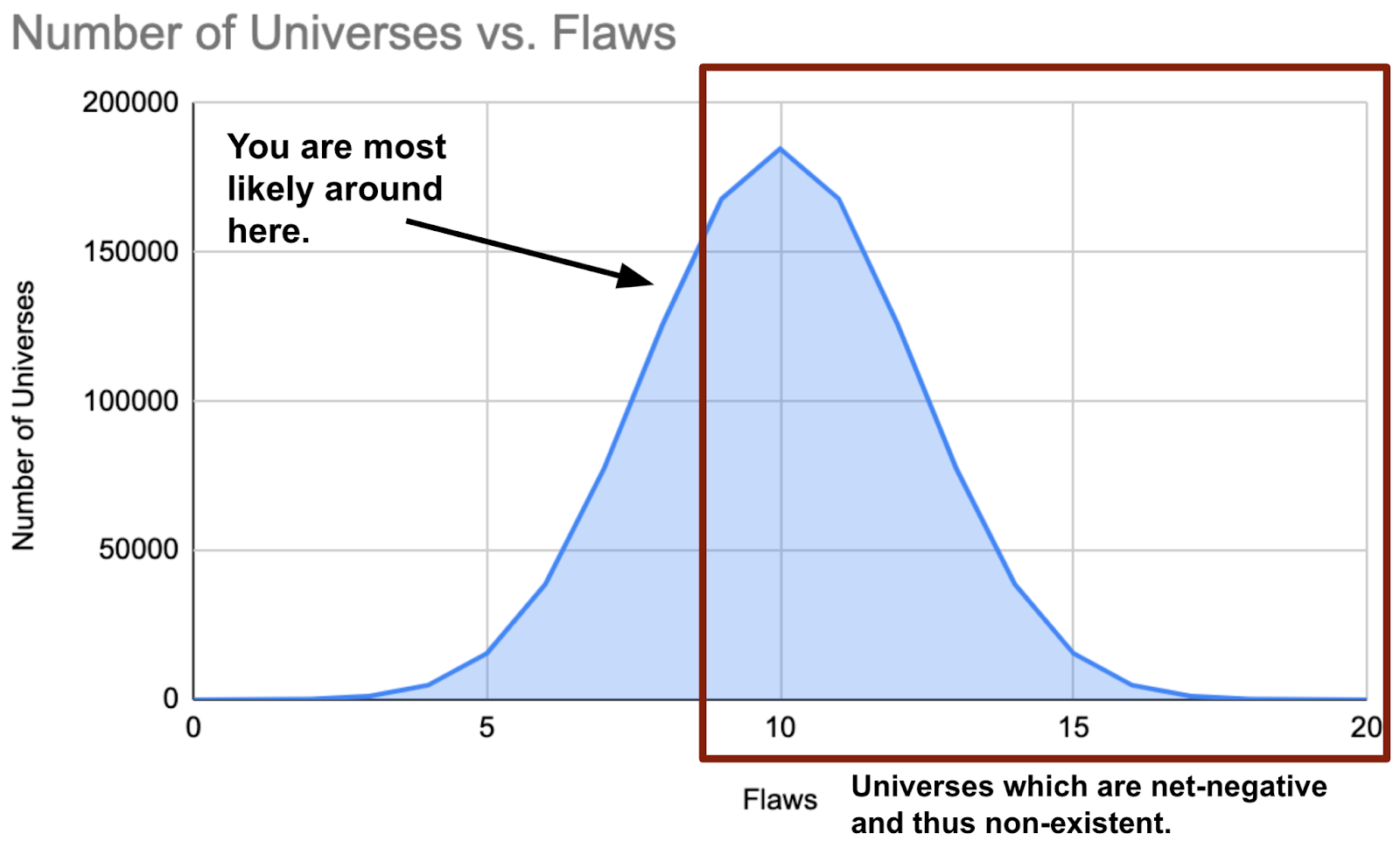
    <content type="html"><![CDATA[<p><em>[Contains spoilers for Unsong.]</em></p><p>Since time immemorial, people have asked how evil can exist in a world created by an omnipotent and benevolent God<sup>[1]</sup>.</p><p>And since time immemorial, God has remained silent.</p><p>In his absence, <a href="https://slatestarcodex.com/2015/03/15/answer-to-job/">Scott Alexander provides an elegant solution</a>. God created every net-positive universe. He created the perfect one, the almost perfect ones, the less perfect ones… all the way down to our universe which is full of misery and suffering, but still, on balance, worthy of existence. As <a href="http://unsongbook.com/chapter-71-but-for-another-gives-its-ease/">Scott explains on God’s behalf</a>:</p><blockquote><p>I CREATED MYRIADS OF SUCH UNIVERSES. WHEN I HAD EXHAUSTED ALL POSSIBLE UNIVERSES WITH ONE FLAW, I MOVED ON TO UNIVERSES WITH TWO FLAWS, THEN UNIVERSES WITH THREE FLAWS, THEN SO ON, AN ENTIRE GARDEN OF FLAWED UNIVERSES GROWING ALONGSIDE ONE ANOTHER…</p><p>YOUR WORLD IS AT THE FARTHEST EDGES OF MY GARDEN… FAR FROM THE BRIGHT CENTER WHERE EVERYTHING IS PERFECT AND SIMPLE. THERE IS A WORLD MADE OF NOTHING BUT BLISS, WITH A GIANT ALEPH IN THE CENTER. THERE IS ANOTHER WORLD MADE OF NOTHING BUT BLISS WITH A GIANT BET IN THE CENTER. AND SO ON, BUT MAKE A MILLION MILLION WORLDS LIKE THOSE, AND YOU START NEEDING TO BECOME MORE CREATIVE.</p></blockquote><p>This is a good start, but it only kicks the can down the road. Why are we at the edge of the garden? Even if we buy that all universes except the single flawless one will contain some evil, it sure seems like our universe contains an awful lot of it. Is that just by chance?</p><hr><p>The easy answer is selection bias, and the <a href="https://en.wikipedia.org/wiki/Anthropic_principle">anthropic principle</a> in particular<sup>[2]</sup>. Were we in the flawless universe, we would not bother asking about evil, since no such thing would exist<sup>[3]</sup>. So given that we’re asking at all, it’s because we’re in a universe with evil, and thus the question provides its own answer.</p><p>But again, we’re not talking about <a href="https://www.lesswrong.com/posts/3wYTFWY3LKQCnAptN/torture-vs-dust-specks">dust specks</a> or <a href="https://unsongbook.com/interlude-%D7%99-the-broadcast/">platypuses</a> or other minor oddities, we’re talking about the unfathomably abhorrent evils of our universe. Given that there is a wide range of universes with sufficient evil to provoke questions, it still seems peculiar that we ended up in one so far along the spectrum.</p><p>Maybe theodicy is possible in all flawed universes, but more common in the worse ones? I don’t think so. Were we to exist in a universe where precisely <a href="https://en.wikipedia.org/wiki/The_Ones_Who_Walk_Away_from_Omelas#Plot">one person suffered immensely</a>, would that not be even more troubling than our own? It is at least possible to dismiss the evils in our universe as the product of chaos. It would be far stranger to live in a world that is nearly perfect but still contains evil. As <a href="https://forum.effectivealtruism.org/posts/RkPK8rWigSAybgGPe/a-longtermist-critique-of-the-expected-value-of-extinction-2#1_2___ERR_under_suffering_focused__totalist__non_person_affecting_axiology">Dostoyevsky once asked</a>:</p><blockquote><p>answer me: imagine that you yourself are building the edifice of human destiny with the object of making people happy in the finale, of giving them peace and rest at last, but for that you must inevitably and unavoidably torture just one tiny creature, that same child who was beating her chest with her little fist, and raise your edifice on the foundation of her unrequited tears—would you agree to be the architect on such conditions?</p></blockquote><hr><p>A better answer comes to us from information theory and entropy. Namely: there are simply more disordered states than there are ordered ones.</p><p>Consider the perfect universe as described by a bit-string of length N. The universities with one flaw are thus described by the same bit-string, but with a single error. Omitting duplicates, there are N one-error universes:</p><p><img src="https://lh5.googleusercontent.com/QY9wkHyQCdRv0ir4fbdJRD01vzQT8STwcqSmR7yooxLadIUVyLqrDoi1sKX8ygWCrDegdKRu0Pvu3D-hvFauAGPJ2dspNKZ-4hO4avTy3kD1Ei8pLcT4aw1vNsqoIHyRGUXSvEBO32DvqhCQBQ" alt=""></p><p>Next we get to two-error universes, and the possibilities explode rapidly. Formally, there are <code>n! / (2! (n-2)!)</code> two-error universes, and <a href="https://en.wikipedia.org/wiki/Binomial_coefficient">in general</a>, <code>n! / (k! (n-k)!)</code> k-error universes. Or defined recursively, the number or k-error universes is equal to the number of (k-1)-error universes multiplied by <code>(n-k)/k</code>. For large n and small k, this grows exponentially.</p><p>Taking this to its logical conclusion, we get that the space of possible universes looks less like a neat circular garden we happen to be towards the edge of, and more like a very very skewed distribution in which nearly all universes that exist are really flawed:</p><p><img src="https://lh4.googleusercontent.com/eQfOjTEXHdfQHiLJmmOvKdmqdt1-yDnB_5QZ6Rur-DZdsa5awO-TrSdifZzF65zIqiQBN73XfM08fFScwbva5fsR6eAAZUF42tTZIK1Xu3Tp0BStTHcIHfLFrOooqH_Ip1UisjXePEdCEDHJcQ" alt=""></p><p>That’s all to say: As you add flaws to the perfect universe, the number of possible universes expands really quickly, such that if you are being randomly placed in a universe, the bulk of the probability lands on the set of maximally flawed universes that are still net-positive. And this fact is sufficient to explain the problem of evil without having to resort to weird appeals to <a href="https://en.wikipedia.org/wiki/Problem_of_evil#Free_will_defense">free will</a> or the <a href="https://en.wikipedia.org/wiki/Problem_of_evil#Evil_as_necessary">necessity of evil</a>.</p><h3 id="Addendum">Addendum</h3><p>Astute readers will notice that the binomial theorem does not expand forever. As <code>k</code> reaches <code>n/2</code>, the function begins to contract. Just as there is only one perfect universe, there is only one maximally flawed universe. And even before the function contracts, it begins to slow, violating the assumption that the vast majority of possible existences cluster right around the worst possible net-good universe.</p><p>There are two ways to avoid these inconvenient aspects of our model.</p><p>The first is simply to suggest that the net-good cutoff occurs prior to the reversal:</p><p><img src="https://lh4.googleusercontent.com/npdxw1fjzwY5WUSz77D-SK9K5o5IqABBHkqG7zORYqf529FOaKTHYpfWdh3zHOKrgPoZu-ITSOmEpmGc28SNkTGVNGpbs4L_DgudOsEM42nt3v9ySRxpzl9TK5hsTD2dHIxyAuTP5nQWbfJAJw" alt=""></p><p>This is a reasonable assumption if you consider goodness to be fragile, and evil to be born from chaos. The maximally likely universe is the one with no structure of all, who’s configuration is purely random, and thus has no godly design. Hoping that it comes out net-good is like sending a tornado into a supermarket and hoping a decent meal comes out the other side.</p><p>Our second option is to claim that “introducing flaws” to a perfect universe is best modeled not as corrupting individual bits, but through some other process that grows strictly exponentially. Consider elsewhere in Unsong where <a href="https://unsongbook.com/interlude-%D7%A1-binary/">Scott describes his own information theory-inspired theology</a>:</p><blockquote><p>God is one bit. The bit ‘1’… it’s easy to represent nothingness. That’s just the bit ‘0’. God is the opposite of that. Complete fullness. Perfection in every respect.</p></blockquote><p>Rather than corrupting that single bit, flaws are introduced by appending new bits onto the end. It doesn’t even matter what they are, since anything other than God itself introduces an imperfection:</p><img src="https://lh5.googleusercontent.com/MKVNu-geG206ZTLuwtOokmpik1Br9zY786AsTV-ovSKJ49UBFIYJDudoXwRbv0K4Ffz7FbhB5FnTUk8g8U1pv7iDByggUAKi1_8nRZw8qKyff3ahhLbVP9vCdG25dmqZMMwJ9JyHkrw6tzVCOQ" style="max-width: 400px" /><p>In this case, the number of possible universes simply increases exponentially as a function of the number of errors, again making it overwhelmingly likely that you are amongst the worst possible net-positive universes. Formally, there’s a ~50% chance we’re in the most flawed set of universes, a 25% chance we’re in the second most flawed set, and so on.</p><h3 id="Addendum-2">Addendum 2</h3><p>Another possible answer is that we’re not far along the spectrum at all. Horrific as it may be to contemplate, maybe our universe is not bad at all, but merely average.</p><p>To be specific, not average amongst all universes that could exist, but merely amongst the ones that are good on balance. The implication is that you could double that amount of suffering in our world to get to a universe that is net-neutral: exactly as good as it is bad.</p><p>It is tempting to dismiss this outright. There is already so much evil, that doubling it would seem to obviously render the university net-negative. The holocaust as we experienced it was sufficient to make many lose faith altogether, the idea of a tragedy of double it’s magnitude existing in a merely net-neutral universe feels ludicrous<sup>[4]</sup></p><p>Even ignoring the impossibility of summing up human welfare to figure out where we fall on the spectrum of net-positive universes, this entire line of argument seems to fail since the value of a universe is determined by its entire timeline including the future, not merely the history up until the current moment. So wherever your intuitions stand now about the balance of good and evil in our world, this is all just the prelude to a much longer history, and we can’t reasonably expect our experience thus far to be representative.</p><p>But wait, if human-history to date was net-negative, but our future will be glorious and good, couldn’t God just create the universe starting now and then implant memories, star dust, fossils, etc, to make it seem like the universe had gone on for much longer?</p><p>Come to think of it, what makes you convinced that he didn’t?</p><h3 id="Footnotes">Footnotes</h3><p>[1] Since <a href="https://www.gwern.net/Modus#:~:text=One%20man's%20modus%20ponens%20is,based%20on%20an%20implied%20conclusion.">one man’s modus ponens is another man’s modus tollens</a>, we might also ask: how can God exist in a world that contains evil?</p><p>[2] You know something has gone wrong when anthropics is the easy answer.</p><p>[3] Really, if we were in the flawless universe, we would not be “beings” at all in the sense you and I understand the term, nor actually capable of asking questions. Scott again:</p><blockquote><p>IN THAT UNIVERSE, THERE IS NO SPACE, FOR SPACE TAKES THE FORM OF SEPARATION FROM THINGS YOU DESIRE. THERE IS NO TIME, FOR TIME MEANS CHANGE AND DECAY, YET THERE MUST BE NO CHANGE FROM ITS MAXIMALLY BLISSFUL STATE. THE BEINGS WHO INHABIT THIS UNIVERSE ARE WITHOUT BODIES, AND DO NOT HUNGER OR THIRST OR LABOR OR LUST. THEY SIT UPON GOLDEN THRONES AND CONTEMPLATE THE PERFECTION OF ALL THINGS.</p></blockquote><p>[4] Is it even more ludicrous for us to draw the line between 6 million and 12 million? First, this whole thing is predicated on us teetering on the edge of losing faith anyway. Second, everyone has their breaking point. <a href="https://unsongbook.com/chapter-58-and-now-the-form-of-enion/">Scott again</a>:</p><blockquote><p>He told me it didn’t work that way. Everyone’s willing to dismiss the evil they’ve already heard about. It’s become stale. It’s abstract. People who say they’ve engaged with the philosophical idea of evil encounter evil on their own, and then suddenly everything changes. He gave the example of all of the Jewish scholars who lost their faith during the Holocaust. How, they asked, could God allow six million of their countrymen to perish like that?</p><p>But read the Bible! Somebody counted up all the people God killed in the Bible, and they got 2.8 million. It wasn’t even for good reasons! He kills three thousand people for worshipping the Golden Calf. He kills two hundred fifty people for rebelling against Moses’ leadership. He kills fourteen thousand seven hundred people for complaining that He was killing too many people, I swear it’s in there, check Numbers 16:41! What right do we have to lose faith when we see the Holocaust? “Oh, sure, God killed 2.8 million people, that, makes perfect sense, but surely He would never let SIX million die, that would just be too awful to contemplate?” It’s like – what?</p><p>The lesson I learned is that everybody has their breaking point, the point where they stop being able to accept things for philosophical reasons and start kicking and screaming.</p></blockquote><h3 id="Coda">Coda</h3><p></p><blockquote class="twitter-tweet"><p lang="en" dir="ltr">rats be like &quot;there is a beautiful solution to this philosophical problem but I don&#39;t want to spoil the ending of UNSONG&quot;</p>&mdash; Nathan (@NathanpmYoung) <a href="https://twitter.com/NathanpmYoung/status/1518935502497501184?ref_src=twsrc%5Etfw">April 26, 2022</a></blockquote> <script async src="https://platform.twitter.com/widgets.js" charset="utf-8"></script><p></p>]]></content>


    <summary type="html">&lt;p&gt;&lt;em&gt;[Contains spoilers for Unsong.]&lt;/em&gt;&lt;/p&gt;
&lt;p&gt;Since time immemorial, people have asked how evil can exist in a world created by an omni</summary>


  </entry>
  
  <entry>
    <title>Corporate Culture is the Final Holdout of Mainstream America</title>
    <link href="https://applieddivinitystudies.com/resignation/"/>
    <id>https://applieddivinitystudies.com/resignation/</id>
    <published>2022-04-05T07:00:00.000Z</published>
    <updated>2022-04-05T23:10:39.922Z</updated>
    
    <content type="html"><![CDATA[<p>At the Atlantic, Derek Thompson wants to push back against the anti-work narrative . Contrary to what you may have heard, he <a href="https://www.theatlantic.com/newsletters/archive/2022/03/american-great-resignation-hate-work/627761/">insists that Americans are in general, quite content to work</a>.</p><p>In his view, Americans do want to work, they’re satisfied with the jobs they have, and the recent increase in quitting reflects not an increase in Marxist sentiment, but rather an increase in opportunity. People don’t quit because they hate capitalism, they quit to take better jobs.</p><p>Just looking at top level indicators, there’s good evidence for this. Since the start of the pandemic, quits are way up, but the Labor Force Participation Rate (LFPR) seems on track to recover:</p><p><img src="https://lh3.googleusercontent.com/K1AywHwyMq3d2YiiHur9HpvQWLOm0R2-6IJPyv5xe5vEvWMsmSRIdxxPmHfoFPSgtPlwGc_QR5jgfu2YcVAU2aXzvNHuXO0Zt5pzXWlLdqGfkPj8cxY4WV2FyKuIgalUytHD0fkD" alt=""></p><p><sup><em>Monthly Nonfarm Quit Rate. Source: <a href="https://fred.stlouisfed.org/series/JTSQUR">FRED</a></em></sup></p><p><img src="https://lh6.googleusercontent.com/YUZ-EZaDX9AVqvF0D8ZD8ZQB6lGPJaRUtw0s-BGpM6Olnn7hmt32wjH52UFf027rpZaDXNvB2P81afW1FgPn1jj-L91q-o0d8br4lhu_a0HuO3dH2BEIK5WZCKYLd-KG2mQ469Dq" alt=""></p><p><sup><em>Labor Force Participation Rate. Source: <a href="https://fred.stlouisfed.org/series/CIVPART">FRED</a></em></sup></p><p>Those are the only two graphs you really need to make Thompson’s point. People are quitting their jobs, but they’re not quitting the workforce. So the Great Resignation is, as Thompson puts it, the “Great Job Switcheroo”.</p><p>…Except that Thompson doesn’t use those graphs. Instead he relies on a mishmash of poorly chosen and even more poorly interpreted metrics.</p><p>Let’s start with his argument that Americans are satisfied at work:</p><blockquote><p>From 2018 to 2021—after an economic crisis, mass layoffs, and a surge in unemployment—the share of very or moderately satisfied workers fell from about 88 percent to … about 84 percent. These numbers aren’t outliers. They’re part of a boring tradition of American workers telling pollsters that they aren’t drowning in a sea of misery.</p></blockquote><p>First, note that there is some selection bias happening here. The satisfaction numbers Thompson uses are only drawn from people who have full-time or part-time jobs. So if someone is so disgruntled that they leave the workforce entirely, that actually pushes job satisfaction numbers up.</p><p>Second, the 4% drop might not feel like an outlier, but it is a serious departure from historical norms. It’s lower than the metric has been since 1984, making it the second lowest satisfaction rate on record. And just looking at recent years, a fairly clear departure from the norm:</p><p><img src="https://lh6.googleusercontent.com/jZhoPsXBjSEx1AWew_mjBYnqtYZihSZZ5FylQFOiQBz2W1ZskzYXadOQ991HZKGCKL5EbIsYOlVsmHUdb2Op2KNCKNPnGWm_ivdq0089dZHGRhoIuhISkrfEymqFwaxcaZ2nLohz" alt="" title="Chart"></p><p><sup><em>Data from the <a href="https://gssdataexplorer.norc.org/variables/2838/vshow">General Social Survey</a>. <a href="https://docs.google.com/spreadsheets/d/1g26nwS8QlP5PB9I9FC3VaiFP-pcs7daDChzw0YLFig8/edit#gid=97203859">Source for charts</a>.</em></sup></p><p>It’s worse than even that chart would suggest. Since we’re debating the existence of employees quitting out of burnout or resentment, we should we really be looking at the other end of the spectrum: the rate of respondents reporting “very dissatisfied”. Here, the rate was at 5%, over twice the 2018 rate of just 2.46%. That is a serious departure, and on a metric more important for explaining an increase in quit rate.</p><p>Similarly, this is the worst the metric has been since 1984 when we hit 5.5% “very dissatisfied”, and the second worst report on record since the survey started collecting data in 1973.</p><p>You might feel that even with big swings compared to historical averages, the absolute numbers just aren’t that big, and this still doesn’t feel like a huge shift towards worker resentment. Aggregated across the entire national population, a 4% drop is equivalent to 6.6 million people newly dissatisfied <sup>[1]</sup>, constituting a fairly substantial cohort.</p><p>Next, Thompson turns to another leg of the Great Resignation narrative, attempting to debunk the idea that quits are driven by resentment. As he writes:</p><blockquote><p>let’s address this pesky claim that the Great Resignation, or “quitagion,” or whatever is a reflection of job hatred and burnout. The Great Resignation isn’t a dramatic shift in worker sentiment. It’s a dramatic shift in worker opportunity.</p><p>…A greater share of people say they are contemplating quitting than express dissatisfaction with their current job,&quot; <a href="http://wrote">wrote</a> Scott Schieman, a sociology professor at the University of Toronto who helped run the survey. Put simply, resignations are rising because people are seeing more job listings, not because they’re feeling more Marxist.</p></blockquote><p>I’m all for relying on the credentials of established experts, so long as you actually represent their work correctly. But follow Thompson’s link, and you’ll find that Shieman explicitly denies this interpretation:</p><blockquote><p>In 2018, about a quarter of respondents said finding another job would be very easy. I asked the same question in my 2021 survey and found that number had actually decreased to around 22%.</p><p>This means that worker confidence or optimism about finding a palatable alternative job has not climbed all that much, making it less likely to be a factor in driving the current wave of resignations.</p></blockquote><p>Thompson is right that not all quits are driven by increased dissatisfaction, but that doesn’t mean a large share of them can’t be. And more to the point, it doesn’t actually provide evidence for his “increased opportunity” narrative, which is hard to square with the reality that fewer workers feel they could get another equally good job.</p><p>So what’s actually happening? I think The Great Resignation is less about the recent increase in quits and dissatisfaction, and more about the voicing of a long term trend. I mentioned at the beginning that the Labor Force Participation Rate was on track to recover to its pre-pandemic highs, but that’s only half the story. The other and much more important trend is the long term decline in LFPR that’s been going on for decades:</p><p><img src="https://lh4.googleusercontent.com/usEwXEt_ZBsVxHYiPkRyywVsyPoekxUbOwYKuRiCATR0jmlgulRypruYJfYz72_U7SoqZGsbsap9ukh6eFSjlv5Q6fyMBLBBhZtcqZut0tmzMLvaEcIMb9X5mVcmYBbjGvVu6TF7" alt=""></p><p>Starting around 1965, we see a steady increase as civil rights, progressive social norms and innovations like birth control enable the entry of more Americans into the professional workforce. There are pronounced effects on LFPR for <a href="https://fred.stlouisfed.org/series/LNS11300002">women</a>, <a href="https://fred.stlouisfed.org/series/LNS11300006">black</a> and <a href="https://fred.stlouisfed.org/series/LNS11300009">hispanic</a> Americans in particular.</p><p>But by 2000, we shift course. LFPR for women plateaus just under 60%, ending rapid “catch up” growth. Meanwhile, the entire time, another trend has been steadily pushing LFPR down. For Men, LFPR has been dropping as long as we’ve been measuring it, from a high of 87.4% in 1949, down to our current rate of just 68.3%.</p><p><img src="https://lh6.googleusercontent.com/6WVBE_z2003GNYayrCQiAp3bjH5Zob77vmz5KvWwR5vCz8p8gdrsGh5IQBTC-6bEtpjM4fU_6Rjk_d5c2IwSWaydpHEDWtVe8i6e8cetV0qJT0E4Ocg7DuRx5PWG1cXXVcn0dawz" alt=""></p><p>Even for women, the rate has decreased modestly since its early 2000s peak, now down to 56.8% from a high of 60.3%.</p><p><img src="https://lh5.googleusercontent.com/NX3XdwIBMDJRqQkcLbprgpi3uIi-AljUfSezbSuTu8Sc8g4IahXRiJ6IaJUjhan9xLGq-fNR3IeptHYmky6W1TXZcpx0e_khsVHdoRCtLXwGPFA0wH_1N9MuCFqIBmBqLj67gHzn" alt=""></p><p>Again, these are seemingly small changes that correspond to huge demographic shifts. Nearly 2 out of 10 men who would have been working in 1949 are now neither working, nor pursuing work. More speculatively, I’m willing to guess that these are the kinds of people who would have disproportionately showed up on the General Social Survey as “very dissatisfied” at work, meaning that the 5% figure we see today could be artificially lowered by selection effects. Basically, it’s not a good indication of the percent of people who actually dislike work.</p><p>I think what we’ve seen lately is a relatively small shift in quits and LFPR, accompanied by a massive cultural change in how acceptable it is to say you hate work. And not in a “water cooler conversation” kind of a way, but in a “I literally don’t want to have a job” kind of way.</p><p>This isn’t quite “Marxist sentiment” as Thompson describes it, but it’s an important shift in norms all the same. Ten years ago if you said you never wanted to work, people would think you were pathologically lazy. Now you can proudly say that you “don’t have a dream job because I don’t dream of labor”, and it’s not seen as a character flaw, but as the awareness that capitalism is exploitative. So exploitative in fact, that refusing to work is actually a kind of radical resistance, and any ensuing financial troubles actually a kind of noble martyrdom.</p><p>In some ways, this is just hippie rhetoric seeing a revival, but that doesn’t mean we should underestimate it. A common refrain is that a genuine counter-culture can’t exist anymore because there’s no longer a coherent mainstream culture to rebel against. This is true for television, and for news and for radio and everything else, but it’s not true for work.</p><p>There’s some variation, but not so much that we can’t all laugh at the same Dilbert jokes about bureaucracy, corporate jargon and office politicking. By and large, corporate cultures converge on the same optimally gray morass. It’s the last truly ubiquitous force in American culture.<sup>[2]</sup></p><p>That means that anti-work is viable as a genuine subculture in a way that nothing has been for decades, and we ought to be prepared.<sup>[3]</sup></p><p><strong>Footnotes</strong><br>[1] Civilian Noninstitutional Population of 263m, with a Labor Force Participation Rate of 62.4%, means a shift from 88% satisfaction to 84% satisfaction corresponds to 263m * 0.624 * 0.04 = 6.6 million people.</p><p>[2] There’s public school too, but only for children.</p><p>[3] It won’t all come in the form of resignation. It will look like playing video games while working from home, <a href="https://www.wsj.com/articles/these-people-who-work-from-home-have-a-secret-they-have-two-jobs-11628866529">working multiple jobs in secret</a>, starting side hustles, <a href="https://www.reddit.com/r/financialindependence/">retiring early</a>, contracting for Uber, <a href="https://www.statista.com/statistics/185160/number-of-masters-degrees-by-gender-since-1950/#:~:text=In%20the%20academic%20year%20of,students%20earned%20a%20Master's%20degree.">becoming increasingly overeducated</a>, working for DAOs, <a href="https://www.bloomberg.com/graphics/2021-citylab-how-americans-moved/">moving to areas with a lower cost of living</a>, having more roommates, <a href="https://www.pewresearch.org/fact-tank/2020/09/04/a-majority-of-young-adults-in-the-u-s-live-with-their-parents-for-the-first-time-since-the-great-depression/#:~:text=The%20number%20living%20with%20parents,all%20four%20main%20census%20regions.">moving back in with your parents</a>, living more frugally, and <a href="https://applieddivinitystudies.com/latte/">making your own coffee</a>.</p>]]></content>


    <summary type="html">&lt;p&gt;At the Atlantic, Derek Thompson wants to push back against the anti-work narrative . Contrary to what you may have heard, he &lt;a href=&quot;htt</summary>


  </entry>
  
  <entry>
    <title>San Francisco Shoplifting: Much More Than You Wanted to Know</title>
    <link href="https://applieddivinitystudies.com/sf-crime-2/"/>
    <id>https://applieddivinitystudies.com/sf-crime-2/</id>
    <published>2022-02-19T08:00:00.000Z</published>
    <updated>2022-02-20T22:10:28.327Z</updated>
    
    <content type="html"><![CDATA[<p><a href="https://applieddivinitystudies.com/sf-crime-1/">Some people</a> argue that shoplifters in San Francisco are running rampant. I don’t think this is true.</p><p>Instead of a proper introduction, let’s just refute with the strongest arguments off the bat.</p><h3 id="Argument-1-“Forget-the-empirics-for-a-second-and-just-look-at-the-actual-policies-California’s-Prop-47-decriminalises-shoplifting-and-means-that-there-are-no-consequences-for-criminals-That’s-clearly-bad-right-”">Argument 1: “Forget the empirics for a second, and just look at the actual policies. California’s Prop 47 decriminalises shoplifting and means that there are no consequences for criminals. That’s clearly bad right?”</h3><p>In a Marginal Revolution post about San Francisco’s alleged shoplifting spree, economist <a href="https://marginalrevolution.com/marginalrevolution/2021/05/san-francisco-fact-of-the-day-2.html">Tyler Cowen highlights</a> a popular explanation for criminals’ flagrant disregard of the law. As his linked <a href="https://www.nytimes.com/2021/05/21/us/san-francisco-shoplifting-epidemic.html">New York Times article</a> explains:</p><blockquote><p>Five years later, the shoplifting epidemic in San Francisco has only worsened…</p><p>The retail executives and police officers emphasized the role of organized crime in the thefts. And they told the supervisors that Proposition 47, the 2014 ballot measure that reclassified nonviolent thefts as misdemeanors if the stolen goods are worth less than $950, had emboldened thieves.</p></blockquote><p>As Tyler concludes: “yes incentives matter”.</p><p>Similarly, in an article tilted 'San Francisco Has Become a Shoplifter’s Paradise&quot; the <a href="https://www.wsj.com/articles/san-francisco-shoplifters-theft-walgreens-decriminalized-11634678239">Wall Street Journal</a> argues:</p><blockquote><p>Much of this lawlessness can be linked to Proposition 47, a California ballot initiative passed in 2014, under which theft of less than $950 in goods is treated as a nonviolent misdemeanor and rarely prosecuted.</p></blockquote><p>That sounds really bad right? It would be horrible if San Francisco were experiencing an entirely avoidable crime spree due entirely to some ridiculously misguided progressive policy.</p><p>…Except that this causal attribution is not even plausibly correct.</p><p>Though it’s tempting to frame the law as just another artefact of California’s bleeding-heart progressivism, <strong>similar laws are in fact present in all 50 states.</strong></p><p>You might object that other states have different financial thresholds for felonies… which would be a good counter argument except that California is actually on the low end. <a href="https://www.prisonpolicy.org/blog/2020/06/10/felony-thresholds/">Every single US state has a minimum threshold for felony theft</a>, and 38 of them are higher than California’s. <strong>Texas notably has a threshold of $2500, which means you can steal 2.6 more than you could in California before being classified as a felon.</strong> Talk about incentives! [1]</p><p>Or <a href="https://www.pewtrusts.org/en/research-and-analysis/articles/2018/05/22/states-can-safely-raise-their-felony-theft-thresholds-research-shows">from Pew</a>, here’s a useful map of the thresholds across the US, highlighting California’s unusually stringent standards:</p><p><img src="https://lh3.googleusercontent.com/5nTl0yN4Mz9rdjTLoY_FFbXOKqBPiNfr_Wr7UUGxsUhY2hehfkuAM3uSm8r60bKfBfEOCdm2Jqg5aZFz37nhQhOpZUY13cQ4sID5XeymxU69JKKsLGyQLiUzUZ4P3VcwsWuPzXtv" alt=""></p><p>So not only is the law not a San Francisco Matter, or a Chesa Boudin matter, it’s not even a California matter! And even if it were, a study from <a href="https://www.pewtrusts.org/en/research-and-analysis/articles/2018/05/22/states-can-safely-raise-their-felony-theft-thresholds-research-shows">Pew research</a> suggests it wouldn’t have a significant impact on larceny rates anyway.</p><p>Further, as the sources correctly note, the policy was implemented in California in 2014. So even on the basis of their own limited facts, it doesn’t make any sense to blame recent alleged waves of shoplifting on either the new DA or a law that’s been in place for several preceding years.</p><p>Look: this is a complex issue, and some of the following claims will be complex and nuanced.</p><p>But this first one is easy. It’s not even arguable. It’s just poor causal attribution, poor reasoning, and an abject failure to do even the bare minimum of background research before reporting in prestige media outlets.</p><h3 id="Argument-2-“San-Francisco-has-a-shoplifting-surge-but-it’s-not-reported-because-people-know-the-police-won’t-respond-and-the-new-DA-won’t-press-charges-”">Argument 2: “San Francisco has a shoplifting surge, but it’s not reported because people know the police won’t respond, and the new DA won’t press charges.”</h3><p>This is a compelling view, and one that puts us into a seductively militant position. What’s the point of arguing about data if we have good reason not to trust it?</p><p>Fortunately, there is still an avenue to find good evidence: every neighbouring county.</p><p>Imagine you’re an organised criminal in the Bay Area, but not living in San Francisco proper. Perhaps you’re across the Golden Gate Bridge in Sausalito, or across the Bay Bridge in Oakland. One day, San Francisco elects a new District Attorney who’s famously soft on crime and refuses to prosecute shoplifters. Do you:</p><ul><li>A) Continue to shoplift in Oakland where you might be caught and punished, or</li><li>B) Take a 15 minute BART ride to San Francisco where you can shoplift with impunity?</li></ul><p>In other words, if San Francisco is truly the “<a href="https://www.wsj.com/articles/san-francisco-shoplifters-theft-walgreens-decriminalized-11634678239">shoplifter’s paradise</a>” it’s critics claim, we shouldn’t just expect to see a rise in cases locally, we should expect a drop in cases in all of its neighbours. Shoplifters should be virtually swarming from across county lines to partake in the unencumbered criminality.</p><p>Instead, here’s how shoplifting changed in adjacent counties from 2019 to 2020:</p><img src="https://lh3.googleusercontent.com/L6EwIZMHSm37JFjmwDcgy0w_zdPfdbLARehHklxOM2Zv3fvKQaPuZOCD1NLiPAFDURvgIGqNgaFdgVo5n3-1GUgb2DSNpCE2sj6h193J3tNEjmpCdzH0pHnJ8d1biKla4Diie2_j" style="max-width: 500px"/><p><sup><em>[Decline in shoplifting reports in San Francisco, adjacent counties and California as a whole from 2019 to 2020. Data from the <a href="https://openjustice.doj.ca.gov/exploration/crime-statistics/crimes-clearances">California Department of Justice</a>, compiled in this <a href="https://docs.google.com/spreadsheets/d/1pEF4ywDKAxUlNHvkVnCEzGjiV4N-XgnkKbDUOnNxjOc/edit?usp=sharing">Google Sheet</a>.]</em></sup></p><p>It’s tricky, cases do fall, but most of that is pandemic effects. When compared to the state as a whole, adjacent counties saw relatively little decrease in shoplifting (with the slim exception of San Mateo). That’s the exact opposite of what you would expect to see if criminals were following their alleged incentives.</p><p>Faced with the San Francisco data alone, you might argue that residents have given up on the DA, so reports are down even as crime is up. But it’s hard to tell a similar story about adjacent counties’ apparent lack of reported decline.</p><p>(You might argue that this only proves the problem runs deeper than DA Chesa Boudin, and deeper than San Francisco, and is really about California as a whole being too soft and liberal. But again, think about what the data tells us. It’s not just that Marin County has more or less shoplifting than the state as a whole, it’s that upon a specific intervention (the election of a new DA), shoplifting in Marin County dropped less, indicating a lack of substitution into San Francisco.)</p><p>The problem with the “residents don’t bother reporting” view is that it’s simply too compelling. It allows us to ignore data, ignore nuanced argumentation, ignore even the semblance of rigour, all while taking the moral high ground of a “man on the street” aligned with the interests of “everyday people”.</p><p><a href="https://twitter.com/sama/status/1410251675395264517">As concerned resident Sam Altman</a> writes:</p><blockquote><p>“The thing I have noticed is when the anecdotes and the data disagree, the anecdotes are usually right. There’s something wrong with the way you are measuring it” -Jeff Bezos</p><p>This is how I feel about SF crime data. Almost everyone I know who lives here is experiencing more.</p></blockquote><p>As tempting as it is, we can’t fall prey to this kind of quantitative-nihilism. The problem with anecdotes isn’t just that they’re biased, subject to selection effects, and so on, it’s that everyone has their own experiences, so we can go on disagreeing with each other, sometimes violently, until the end of time.</p><p>In contrast, if you don’t like my data, it’s <a href="https://docs.google.com/spreadsheets/u/1/d/1pEF4ywDKAxUlNHvkVnCEzGjiV4N-XgnkKbDUOnNxjOc/edit?usp=sharing">here for you</a> to independently investigate, criticise, reproduce, etc. It’s not objective, and it’s not a perfect science, but we can at least have a conversation rooted in some common understanding of what evidence is out there, and we can make shared epistemic progress.</p><p>So the lesson here is that San Francisco’s doesn’t seem to be much softer on crime than the rest of California, but the meta-lesson is that when one data source is known to be poor, you don’t have to give up, you just have to find other angles of attack.</p><h3 id="Argument-3-“We-know-San-Francisco-has-a-shoplifting-problem-because-stores-are-closing-That-can’t-be-faked-and-wouldn’t-happen-otherwise-so-it’s-strong-evidence-that-the-city-has-a-real-problem-”">Argument 3: “We know San Francisco has a shoplifting problem because stores are closing. That can’t be faked and wouldn’t happen otherwise, so it’s strong evidence that the city has a real problem.”</h3><p>Some staunch anti-capitalists might say “Walgreens is closing? Good. Screw corporate profits.” [2]</p><p>Let me clarify that this is not my view. As an armchair urbanist like the rest of you, I think that dense urban walkable neighbourhoods are critical to thriving communities, and though a small local business might be preferable to a chain pharmacy, the latter is still strongly preferable to nothing. When stores close, communities lose access to groceries, over the counter medicine, prescription pickup, Covid vaccinations and much more.</p><p>So if store closures are undeniable and tragic, why do I disagree? Because you’re still <a href="https://en.wikipedia.org/wiki/Base_rate_fallacy">ignoring base rates</a>.</p><p>Yes, <a href="https://www.sfgate.com/bayarea/article/Walgreens-closing-5-Sf-stores-crime-shoplifting-16527801.php">Walgreens announced the closure of 5 stores throughout the city</a>. I’ve heard this cited over and over again. What I haven’t seen is discussion of how that compares to their historical average closure rate, the average closure rate of comparable stores in comparable cities, and so on. What we’re asking is not “did Walgreens close stores”, but “are these closures unusual enough to serve as evidence of a broader societal ill?”</p><p>According to the <a href="https://www.sfchronicle.com/local-politics/article/Out-of-control-Organized-crime-drives-S-F-16175755.php">SF Chronicle</a>, there were 17 Walgreens closures in the 5 years leading up to May 2021, and from the <a href="https://www.wsj.com/articles/san-francisco-shoplifters-theft-walgreens-decriminalized-11634678239">Wall Street Journal</a>, another 5 announced in the latter half of 2021, bringing the total to 22.</p><p>So ignoring the most recent year, Walgreens was closing at an annual rate of 3.4 stores. Including 2021, the overall average was 3.7 per year. That makes 5 closures in a single year high, but not extraordinarily so. [3]</p><p>We can also compare SF Walgreens to NYC Duane Reade, a similar outlet owned by the same parent company. <a href="https://nycfuture.org/pdf/CUF_StateoftheChains_2021_final.pdf">Industry data</a> shows that their number of locations plummeted from 317 in 2019, to just 253 in 2020, for a decline of 17%. By comparison, there are still 45 Walgreens left in San Francisco, making their 2021 decline a much more modest 10%.</p><p>Third, we’ll look at how the 2021 Walgreens closures compare to their broader financial outlook. Their stock price is down 39% since 2016, compared to a store closure rate in SF of 33% in the same period. I’m not suggesting store footprints should necessarily be linearly related to stock prices, just that given the existence of a general decline in the chain’s finances, store closures don’t really merit additional explanation or blame.</p><p>For an overall comparison, hear are some rates to consider:</p><p><img src="https://lh5.googleusercontent.com/aVayFXJMm1l9uQFVtX5lLwu7H3h3s08ep6gd7J7rfEYzEW9xp5jQWQGa9Wec5U-eutfTulHm_x2bcOLTcir4AcxyMQpwLqa4taOiX_xLGSaiKEKZxF0PoPIge3k_ASwjGf7fnJC1" alt="" title="Chart"></p><p>The 5 store closures are certainly notable, but taken in context, don’t suggest an extreme deviation from what we might expect.</p><p>What I’m really saying is: store closures are bad, but they are sufficiently well explained by existing non-shoplifting factors, including Walgreens’s general decline, and of course, the global pandemic and subsequent economic shocks that hit in this same time period.</p><p>Rather than naively inferring from stock price, it’s worth taking a closer look at the chain’s financial ills. On a January 6th call with investors, the <a href="https://www.businessinsider.com/walgreens-shrink-rate-50-higher-retail-theft-2022-1">Walgreens CFO detailed</a> how the chain’s shrink rate–loss of inventory due to shoplifting, employee theft, and other causes–has hit 3.25%, up from 2% a decade ago. The phenomenon hasn’t been unique to San Francisco. As shown in data collected from the National Retail Security Survey and <a href="https://www.sfchronicle.com/sf/article/shoplifting-data-Target-Walgreens-16647769.php">charted by SF Chronicle</a>, shrinkage rates are up across the country:</p><p><img src="https://lh3.googleusercontent.com/gDDPG-Qs_7kbs0Sp430qu69JfTT2lZ1zdiNP851yphUSh2yg0Vk-Yv9kFfdBQfOPLqZY5M3F_-QjzH8-pOJmw6qdQmw7rIPtCb4-Z8DHwUrDjy-5CmIiVxXKlqLs2PLxeQRNYqU4" alt=""></p><p>We can further investigate the claim by looking at individual Walgreens. Though some of the five stores with announced closures did see a substantial rise in shoplifting in 2020, <a href="https://www.sfchronicle.com/sf/article/Is-shoplifting-forcing-Walgreens-to-cut-back-in-16536960.php">SF Chronicle reports</a> that the 2550 Ocean Ave. location reported a mere 3 cases throughout the entire year, similar to the 4 cases it reported in 2019. The 4645 Mission St. location reported a mere 3 cases of shoplifting in 2021 (the closure was announced in mid-October).</p><p>Further doubts are cast on the shoplifting-driven closure narrative due to a <a href="https://www.sec.gov/Archives/edgar/data/1618921/000119312519214110/d786644d8k.htm">2019 SEC Filing</a> in which Walgreens announced their plan to close “approximately 200 locations in the United States” as part of their “Transformational Cost Management Program” designed to “achieve increased cost efficiencies”.</p><p>On Twitter, <a href="https://twitter.com/micsolana/status/1448423394333036551">Mike Solana sarcastically quips</a> that the profit-driven motive for closing stores is absurd since “everyone knows the fewer stores you have, the more money you make. ‘going out of business’ is just another nefarious capitalist plot.”</p><p>But in a world transformed by ecommerce, pandemics and labour shortages… that is actually true. It’s not exactly conspiratorial to think that closing unprofitable stores is a good way to raise profits.</p><p>That’s precisely what they explained in their 2019 SEC filing, and even how, up until recently, Walgreens explained specific chain closures. From a <a href="https://www.sfgate.com/local-donotuse/article/Walgreens-to-shut-7th-San-Francisco-store-in-a-yea-15072055.php">February 2020 article</a>, a spokesperson explains that the 730 Market St. store closure was “necessary to cut costs”, and part of the “transformational cost management program to accelerate the ongoing transformation of our business, enable investments in key areas and to become a more efficient enterprise.”</p><p>Finally, we can zoom in to the 2019-2020 to examine the effects of a new DA and look at the <a href="https://www.sfgate.com/bayarea/article/Another-San-Francisco-Walgreens-is-closing-15659279.php">8 stores closed over that time period</a>. Even addresses in hand, it’s hard to find news coverage of specific closures, but I’ve done my best to source dates for each of these locations:</p><ul><li>3801 Third St. – Closed 2019 (<a href="https://sfbayview.com/2019/07/should-a-big-cannabis-chain-store-replace-walgreens-in-bayview-plaza/">source</a>)</li><li>1979 Mission St. – Closed 2019 (<a href="https://missionlocal.org/2019/12/walgreens-on-16th-street-bart-plaza-shutting-down-after-christmas/">source</a>)</li><li>320 Bay St. – Closed 2019 (<a href="https://www.yelp.com/biz/walgreens-san-francisco-156?sort_by=date_desc">source</a>)</li><li>845 Market St. – Closed 2019 (<a href="https://www.yelp.com/biz/walgreens-san-francisco-168?sort_by=date_desc">source</a>)</li><li>116 New Montgomery St. – Unclear, but <a href="https://www.yelp.com/biz/walgreens-san-francisco-113?sort_by=date_desc">their last Yelp review is from June 2019</a></li><li>100 Sansome St. – Unclear, but <a href="https://www.yelp.com/biz/walgreens-san-francisco-112?sort_by=date_desc">their last Yelp review is from November 2019</a></li><li>730 Market St. – Closed 2020 (<a href="https://www.sfgate.com/local-donotuse/article/Walgreens-to-shut-7th-San-Francisco-store-in-a-yea-15072055.php#:~:text=The%20730%20Market%20St.,business%20will%20be%20March%203.&amp;text=Walgreens%20is%20shuttering%20a%20store,San%20Francisco%20for%2021%20years.">source</a>)</li><li>790 Van Ness Ave. – Closed 2020 (<a href="https://www.sfgate.com/bayarea/article/Walgreens-closing-5-Sf-stores-crime-shoplifting-16527801.php#:~:text=Walgreens%20closed%20a%20location%20at,in%20stolen%20merchandise%20every%20day.">source</a>)</li></ul><p>So of the 8 stores closed over the 2 year period, 4 were in 2019, 2 in 2020, and 2 are ambiguous, but have their final Yelp review in 2019. Since these reviews are intermittent, we can’t rely on them entirely, but it’s at least suggestive.</p><p>Overall, it doesn’t look like Walgreens’ 2021 closure rate requires explanation beyond pandemic effects, their own 2019 cost management program, and broader economic trends. Additionally, it appears their 2020 closure rate was below, or at best on par with, their 2019 closure rate, indicating that the new DA, who took office at the start of 2020, did not accelerate the decline of Walgreens in San Francisco.</p><p>Again: I believe that store closures are generally bad. And whether or not it’s a departure from historical and national context, you may feel that another 5 Walgreens closing in 2021 is bad for the city. I agree, but that’s not the question at hand. What we need to understand is whether or not these closures can be blamed on the new DA, “soft-on-crime” policies, or progressive criminal justice reform. And given the evidence presented, the case for that narrative is extremely weak.</p><h3 id="Argument-4-But-I’ve-seen-the-viral-videos">Argument 4: But I’ve seen the viral videos!</h3><p>Look, I’ll admit that these look bad, and that simply appealing to higher faculties is insufficient for dismissing clear, flagrant and frankly shocking instances of shoplifting in a city that just doesn’t seem to care.</p><p>You may have seen this video of two women loading cartfulls of what appears to be laundry detergent and other bath products into the back of a van:<br><img src="https://lh4.googleusercontent.com/IVtTlLlsExctNbEJ40CudocC8J0O3gOXdAlUBB_Ans5YcqrM4pRXwlAwpFWFyqC1lYa5MNXE8ipqFnlILg28k5L6vyYFJ6PixsWO9ahNoFmELxGSBpSJaxlpRolXB0nvOZDgvmqq" style="max-width: 400px"/></p><p>Or this one of two men with what can only be described as humorously large bags walking (not even bothering to run) out of a store:<br><img src="https://lh5.googleusercontent.com/Fsxjbc8jODnFaLv8OYDl5JkGRIp2jbm5f49bf9_mDmWfEXpTm4KCN5JQm2XPwycnrqtgEeKQD6rnYcMDh6cSpARTLKrusdYTP9ssi0S6f67usvva1ZNkrfmqTFj5temBBpKN7apD" style="max-width: 400px"/></p><p>Or this one of a smash and grab inside a mall:</p><img src="https://lh6.googleusercontent.com/De7RTv63zKAh85TnM_TuGsuU73M-VGpDmgw6Fnh-R7YPoVkL20az4sczga8aWXZMiO-evaa6jTpFhRKcv56-CGSuLfMRPENplrtTnsA5r30I6qlXFwTDOamEwdBCvQLcw6AiP7zT" style="max-width: 400px"/><p>If you haven’t guessed, none of these are from San Francisco. The first is in <a href="https://www.youtube.com/watch?v=k2A_zyeTge4">Connecticut</a>, the second in <a href="https://www.youtube.com/watch?v=ftYHfK6KYtE">Granada Hills in LA</a>, and the third allegedly from <a href="https://twitter.com/MercedezUAZ2/status/1493733331485159424">Desert Sky Mall in Phoenix</a>, though I haven’t found a real source. Of course there are videos taken of shoplifters in San Francisco, my point is just that they don’t prove anything.</p><p>I know this is a stupid form of argumentation, but <a href="https://www.reddit.com/r/slatestarcodex/comments/suzu45/comment/hxisgf9/?utm_source=reddit&amp;utm_medium=web2x&amp;context=3">some of you literally asked for it</a>, and I’m sick of spending dozens of hours on data analysis only to get feedback that it can’t possibly be right because it contradicts <a href="https://twitter.com/paulg/status/1494709072414707720">some anecdote you heard from a friend</a>.</p><p>Let me be clear about how this kind of observational data works. If I say “there’s no data proving that sparking unicorns”, and you say “I’ve literally seen one”, then you are right to trust your observations and distrust my data. All the claim calls for is an existence proof, and as far as your experiences are concerned, you have a perfectly valid one.</p><p>On the other hand, if I say “There were thousands of shoplifting cases in San Francisco in 2020 and 2021, I’m just not convinced this represents a sudden increase over previous years”. And you say “But I’ve seen people shoplifting!!!”, that proves approximately nothing. You could show me hundreds of videos, and I still wouldn’t care, because you could have done the same thing in 2019, and you could have done the same in dozens of other cities. So sure, it’s evidence for something, just not the question that’s actually relevant to this debate.</p><p>The past couple years have been difficult. It’s easy to be a doomer, and easy to feel hyper-attuned to things that are going poorly.</p><p>Writing for the New York Times, <a href="https://www.nytimes.com/2021/05/21/us/san-francisco-shoplifting-epidemic.html">bureau chief Thomas Fuller even admits</a> that he bore witness to flagrant shoplifting in the city as early as 2016. But at the time it felt like a one off thing, and in 2022 it now feels like part of some  bigger narrative. You feel that the DA is too progressive. That the BLM protests were too destructive. That the city is too woke. Whatever. None of these macro-narratives good reason to believe that your anecdotes are representative of broader trends, if anything, they’re reasons to think you’re <a href="https://astralcodexten.substack.com/p/book-review-the-scout-mindset?utm_source=url">suffering from confirmation bias</a>.</p><p>You used to live in small tribes and developed a brain eager to generalise from small sample sizes. Now you live in a world of 8 billion people, most of them equipped with smart phones and an internet connection. It’s easy to find anecdotal evidence, and easy to feel like it’s compelling. <a href="https://www.gwern.net/Littlewood#:~:text=The%20Law%20of%20Truly%20Large%20Numbers.,thing%20is%20likely%20to%20happen.">As Gwern once wrote</a>:</p><blockquote><p>The paradox of news is that by design, the more you read, the less you might know, by accumulating an ever greater arsenal of facts and examples which are (usually) true, but whose interpretation bears ever less resemblance to reality.</p></blockquote><p>That’s the reality of our brave new world. I suggest you either develop defences against it, or get off the internet. Better yet, <a href="https://applieddivinitystudies.com/against-news/">stop reading the news altogether</a>.</p><p>If this was a frustrating section to read, I promise it was equally frustrating to write, and I take no joy in these childish bait-and-switch ploys. But don’t give up yet, the next two are better in tone, importance and rigour.</p><h3 id="Argument-5-“Chesa-Boudin-really-is-overly-progressive-He-has-naive-views-about-criminal-justice-and-charging-rates-have-dropped-as-a-result-I-don’t-have-to-prove-that-as-consequences-fall-criminality-goes-up-”">Argument 5: “Chesa Boudin really is overly progressive. He has naive views about criminal justice, and charging rates have dropped as a result. I don’t have to prove that as consequences fall, criminality goes up.”</h3><p>From the <a href="https://www.sfchronicle.com/crime/article/We-obtained-never-before-seen-data-on-Chesa-16592626.php">SF Chronicle analysis</a>, here’s the breakdown of Chesa’s charging rates:</p><p><img src="https://lh4.googleusercontent.com/IpQx8jsP14SAHEaI4Pu8BpBmDc-eWxOoKSgNeJIajPzhh7W2k4Db8-wIf_0CASkNW4dVeo7J5oZDw02SZseEHacXGzo3O44Nh2HnPj8bq6QJwZZExCbgMuv1yUMtO_07e7W-ASFC" alt=""></p><p>They have indeed dropped for theft and petty theft, and by fairly substantial levels! Petty theft in particular is down from 58% to 35%. So is that it? Despite everything, Chesa really is soft on crime, and whatever the other evidence suggests, it would be strange for this change to <em>not</em> result in a dramatic surge?</p><p>Not so fast. Again, we have to understand the results in context. <a href="https://docs.google.com/spreadsheets/d/1pEF4ywDKAxUlNHvkVnCEzGjiV4N-XgnkKbDUOnNxjOc/edit#gid=1827454203">Here are charging rates for Chesa and the previous DA over the last decade</a>, both overall and for larceny/theft:</p><p><img src="https://lh4.googleusercontent.com/jBOQD7Hd4V8roJkLibguPGwKI-ZPeonUTXePL46gIZ4gv8oLddxRFCVXtbKt42xUxkeBmurueh9KaCVJvdNnPVdFF3xjNzPRJMQfFoPyQTYk0W9ZOgOpvjycS6w61I-gwS_EkQVE" alt="" title="Chart"></p><p>There was indeed a sharp drop in 2020, but it was followed by a sharp uptick. For Larceny/Theft, the 2021 rate is still a bit under peak (74% versus 77%), but much higher than the historical average of 61%. His overall 2021 charging rates are even more aggressive, coming in just under the 2018 peak (67% versus 71%), and much higher than the average of 60%.</p><p>In both cases, Chesa’s 2021 rates are higher than those in 7 out of the 9 years preceding his tenure.</p><p>So if Chesa isn’t particularly light on crime, why the drop in 2020? Chesa’s own defence is that logistics were difficult, and he had to prioritise. From the <a href="https://www.sfchronicle.com/crime/article/We-obtained-never-before-seen-data-on-Chesa-16592626.php">same SF Chronicle piece</a>:</p><blockquote><p>Boudin maintains that the drop in charging rates for theft is mainly due to the reduced operation of San Francisco’s court system caused by COVID-19 restrictions. The charging rate for both types of theft increased between 2020 and 2021 as the city reopened, the data shows.</p><p>“We had clear instructions from courts to delay and defer anything we could delay and defer, [and] from the medical director to drastically reduce the (jail) population,” he said. “In the context of those really difficult decisions, we did make intentional decisions to delay or defer charging low-level nonviolent cases.”[4]</p></blockquote><p>Granting his defence, we’re not left asking if Chesa’s charging rates are high enough across the board, but if, given some limited capacity to process cases, he was allocating resources in a reasonable way. Here were his charging rates across the board:</p><img src="https://lh5.googleusercontent.com/CVvivqeBUo0WxbK5omOpK2eOYH7i59_fHOPKwFNFFVU_n-yiso6bS8JfGuZxUfc4T4AxOF00vax9oIZNZKkDFnGi2SG6It9Qovm-udA3oeRmCmYeGPXNawSHXuAg0bEtMAj601TV" style="max-width: 500px"/><p>Here we see that although rates were down for several crimes, they weren’t down across the board, and were higher for rape, willful homicide and narcotics cases. The first two are obviously serious crimes worthy of justice system resources, and though drug policy is controversial, this third category seems fair given <a href="https://www.sfchronicle.com/projects/2022/sf-opioid-epidemic-fentanyl-combination/">San Francisco’s tragic record of drug overdoses</a>.  Overall, it feels like a reasonable allocation of limited resources.</p><p>Finally, you might wonder about the specific instances you’ve heard of where Chesa lets off a criminal, only for them to re-offend, sometimes with horrific consequences. This is obviously bad, but it’s not so much a matter of intense debate as a matter of statistical nuance meeting a human interest story.</p><p>If an innocent person is arrested, we never get to learn about the counterfactual: what could have happened otherwise. On the other hand, if a guilty person is let free and commits another crime, we’re given reason to feel regret and resent the DA.</p><p>I’m not going to wax poetic about liberalism’s virtue of requiring high burdens of proof for criminal charges. The point is just that given imperfections, a statistical classifier will make two kinds of errors, and given the human context, we’re liable to ignore the false positives are ignored, while the false negatives are seared into our collective consciousness.</p><h3 id="Argument-6-“Reported-cases-are-actually-skyrocketing-”">Argument 6: “Reported cases are actually skyrocketing.”</h3><p>It might feel bizarre to put this last, but I’m worried it’s a strawman since very few of Chesa’s critics actually seem to be citing the data. In any case, if we just take <a href="https://docs.google.com/spreadsheets/d/1pEF4ywDKAxUlNHvkVnCEzGjiV4N-XgnkKbDUOnNxjOc/edit#gid=791428213">monthly reports</a>, a disturbing trend does start to emerge:</p><img src="https://lh3.googleusercontent.com/Cn8Yl8kTWh55lRLZj1qPPkRcVY0GRPSp8wSWMEsL5LWPlZ2PiB80oU-UTJuo1KLyMmvC4-NZdAZvCd-ey5cq7dlS5hGOkiKHpBO_6pXC6RuKYhqt9Sw5gnNsITcDj1FcF6aVTBaS" style="max-width: 500px"/><p>Reports were pretty stable around 200, plummeted at the start of the pandemic, slowly rebounded, and then suddenly shot up from 193 in August to 391 in September.</p><p>That sounds bad, until you take a closer look at where the reports are coming from. Or more specifically, the one store where nearly half of all reports originated:</p><img src="https://lh3.googleusercontent.com/WqszWvd2BTzcjb8kKtJG7o6kdjba96uTCrFxAC0m2feLlPAlMYTBUWhm2wQiVIYYMF8iueOkoMa9Bp__6023z9ibLYFHTAo76AGFSetO5GjQDlEmjb_2LLiFQwkIvGn8xV6W6FV-" style="max-width: 500px"/><p><sup style="display: inline-block; text-align: center; width: 100%"><em>source: <a href="https://data.sfgov.org/d/wg3w-h783/visualization#">sfgov.org</a></em></sup></p><p>That’s right, of the 391 reports from September, 155 were from a single location: a Target on Mission and 4th. So what happened? A dramatic crime surge? Not quite, <a href="https://www.sfchronicle.com/sf/article/shoplifting-data-Target-Walgreens-16647769.php">as a spokesperson explains</a>: “The store was simply using a new reporting system.”</p><p>What about October and November? Again, it’s mostly just that one Target location. In October, in a city of nearly a million people, one Target accounted for 39% of all shoplifting reports. In November, it accounted for 35%. To put that into context: In those three months, that Target reported a total of 465 cases, compared to 201 cases it had reported in the previous 44 months combined.</p><p>To correct against the apparent increased caused by their new reporting system, we can replace their reports from those months with the store’s historical average to get a sense for what reports might have looked like:</p><img src="https://lh4.googleusercontent.com/xKbs50hIneWT2oB6yYZZbflVW21_8mmjxhEmEJwZWZB2ETRV4QQw-0yz2LdnUu9BWo5cdPTsoUPW3Pi4Xsb6BeBLc_Ej-cl6KR0_EVgUjKtkuE92MTVofKUV4BqMdKJtwkT76fLd" style="max-width: 500px"/><p>This is starting to look less like a sudden surge and more like a mundane reversion to the mean. But you’ll notice there’s still a sudden surge in November.</p><p>At this point, I was suspicious enough of outliers to investigate further. And sure enough, found a single Safeway that accounts for the entire spike:</p><img src="https://lh4.googleusercontent.com/-1P751lWIgnWpV32OL2b8JFXwQrwhgdjfKSPS1WrSIsw1seC22s6piPQIYCbo7IHG9Y5AJeZrHveYIlovJGDZ2WtXUx65VGGg0OywagrSRMTytyguZUD5g-KZfnFpaaybrNyY9MA" style="max-width: 500px"/><sup style="display: inline-block; text-align: center; width: 100%">_source: [sfgov.org](https://data.sfgov.org/d/wg3w-h783/visualization#)_</sup><p>I wasn’t able to find a similar source confirming that this is due to a change in reporting, but when asked about increased reports at the Target location, a police spokesperson confirmed that “the new reporting system was accessible to other businesses”, so it wouldn’t be too surprising if this Safeway adopted the new system in November.</p><p>Previously, this location had reported just 1 incident per month, compared to 120 incidents in November. Making a similar adjustment, we’re left with a totally unremarkable trend:</p><img src="https://lh5.googleusercontent.com/T6cC18hOpbf1S58FGY4V1DWd5n6DZjiu9tCrZ9EP5SF5ftIaoM25JUGcuH6bjjUQ6FFBFf3JmJvOeEPx0IEGXQpi3HowRx9kfB_1Gs5iuDicicu1rO6EEtXmoOxdBDikrDA5P5_C" style="max-width: 500px"/><p>With those two adjustments made, the spike disappears entirely, and we’re left with something totally expected: a sudden drop at the start of the pandemic, followed by a steady reversion to the historical average.</p><p>Now look, it’s entirely possible that the new reporting system Target uses is better and more accurate than the previous one. In fact, I think it’s likely that they were undercounting before, and that the new data is closer to ground truth. But an odd property of data analysis is that being selectively more accurate, or more accurate all of a sudden, does not necessarily make your overall picture a better one.</p><p>The crucial question at hand is not whether Target suffered 100+ shoplifting cases in a single month, but whether it was an abrupt departure from historical trends. I don’t think the data supports that narrative, but it doesn’t dispel it either. That’s why it’s important to leverage the variety of angles I’ve pursued throughout this piece.</p><h3 id="Conclusion">Conclusion</h3><p>This has been a contentious post, so let me wrap things up with more mundane “good-things-are-good” optimism. Whatever you think of the last couple years, here is the actual macro trend that matters:</p><img src="https://lh4.googleusercontent.com/zIs1aGLPNqWzXumLc99i3J0Smn8y93-aqJoCvhJXxii9TmcpZlGNWu5lD5ibjkqbYHBDFrhY3f03E8btmEPGlHsmWpCSdGF7O7fabZcWz5LIFR2zqTM_MMvRBmEACE5LKMIB8q6F" style="max-width: 500px" /><p>And across non-violent crimes more broadly:</p><img src="https://lh3.googleusercontent.com/CxQvIYhMHnfdqztIQQcoCJKc3nihI5GDb0uubMG9rar2AgR6UqF8n59Lc9G_tnz3xKFEsthOgdUkgFOeKR6z0dmM-mbU23d-aDfKVohCZ6NodIKAdOpEYv7L4tNv3u2mpYZuM-T1" style="max-width: 500px" /><p>And finally, violent crimes:</p><img src="https://lh4.googleusercontent.com/6Ly0pNBHFgVpqvnN_ArogF52S8eQts5MgtQS7WU2FJlpMEqRgJ2QsewLiuz-JaTsYW-quJMnrwXls5UY6PxxV_URRMbLscG4y2fwDITEefHAcRdW0GALAAEeyR7yAC_2bXzGywU9" style="max-width: 500px" /><p>You’re free to have doubts about the veracity of a lot of crime-data, but homicide rates are as close as we get to ground truth. They’re hard to cover up, the police do investigate, and people do bother reporting them. And as we saw, even in 2020, Chesa Boudin’s charging rate for willful homicides was actually above that of his predecessor.</p><p>In a variety of ways, across a variety of important indicators, crime per capita has plummeted in San Francisco over the last 30 years.</p><p>San Francisco remains a focal point for a number of crises, not because it’s unique, but because it’s a uniquely good entrypoint into a host of popular issues. It’s a city that gives conservatives reason to shriek in horror and point out that the progressive-state has failed, while giving liberals an opportunity to bemoan income inequality, housing shortages, gentrification and so on.</p><p>It is tempting to turn the city into a kind of ideological battleground. And in some ways, it should be. If San Francisco fails, it might take many of our brightest technical minds with it.</p><p>But San Francisco is also a real city, inhabited by real people. I mean that in a sentimental way, but also in the sense of <a href="https://slimemoldtimemold.com/2022/01/11/reality-is-very-weird-and-you-need-to-be-prepared-for-that/">being in awe at the complexity of the world</a>. Some police data is bad, that’s fine, you can get around it. Don’t trust the SFPD statistics? You can check them against the California DOJ or FBI numbers. Skeptical about a chart? You can use the <a href="https://data.sfgov.org/d/wg3w-h783/visualization#">sfgov data portal</a> to investigate each individual data point.</p><p><a href="https://astralcodexten.substack.com/p/too-good-to-check-a-play-in-three?utm_source=url">Scott states the law of rationalist irony</a>: “the smugger you feel about having caught a bias in someone else, the more likely you are falling victim to that bias right now, in whatever way would be most embarrassing.”</p><p>And I’m sure it applies here. I’m not a criminologist, or a data journalist, or even a San Francisco resident. I don’t know if I would have voted for Chesa in 2019, or if I would have voted against him in the upcoming recall.</p><p>But I am actually interested in figuring out what’s true, and discussing it beyond shallow politics and useless anecdotes.</p><p>If I’ve made a mistake here, I would love for you to email me and tell me about it so I can share the correction with others. If there’s data I’m missing or could have used more effectively, I would love to hear about that too. And finally, if you have some compelling macro-narrative, speculative or not, that explains all the downright weirdness in all of this, I am happy to discuss it.</p><hr><p><em>Thanks to <a href="https://slimemoldtimemold.com/">Slime Mold Time Mold </a>for comments, and thanks to Maxwell Tabarrok for research assistance with this post.</em></p><hr><p><strong>Footnotes</strong><br>[1] What’s more, only Alaska’s threshold is tied to inflation, and some of these laws haven’t been updated since 1978 (New Hampshire) So there’s a strong argument to be made that the thresholds for classifying theft as felony should be higher in most US states. That same <a href="https://www.pewtrusts.org/en/research-and-analysis/articles/2018/05/22/states-can-safely-raise-their-felony-theft-thresholds-research-shows">Pew report</a> cites one of their <a href="https://www.pewtrusts.org/en/research-and-analysis/issue-briefs/2017/04/the-effects-of-changing-felony-theft-thresholds">studies</a>, explaining that “in the 30 states that raised their thresholds between 2000 and 2012, downward trends in property crime or larceny rates, which began in the early 1990s, continued without interruption. These states reported roughly the same average decrease in crime as the 20 states that did not change their theft laws, and the threshold amounts were not correlated with property crime or larceny rates.”</p><p>[2] Though I will admit that it’s ironic to see so much attention placed on shoplifting under $950 in merchandise, and so little placed on <a href="https://news.bloomberglaw.com/daily-labor-report/walgreens-employees-in-california-secure-4-5-million-wage-deal">Walgreens admitting to millions in wage theft</a> in California alone.</p><p>[3] That might sound weird, but statistically it’s the norm. If you’re trying to detect outliers, you still include outliers in the standard deviation calculation.</p><p>[4] I’m a little hesitant to just take Chesa’s word at face value, and wasn’t able to independently confirm, but adversarial source <a href="https://twitter.com/zebulgar/status/1349954692281896960?s=20">Delian Asparouhov</a> does admit after talking to Chesa that it’s “interesting to think about wtf do you do when you can’t run a jury trial…”.</p>]]></content>


    <summary type="html">&lt;p&gt;&lt;a href=&quot;https://applieddivinitystudies.com/sf-crime-1/&quot;&gt;Some people&lt;/a&gt; argue that shoplifters in San Francisco are running rampant. I d</summary>


  </entry>
  
  <entry>
    <title>San Francisco Shoplifting: Prelude</title>
    <link href="https://applieddivinitystudies.com/sf-crime-1/"/>
    <id>https://applieddivinitystudies.com/sf-crime-1/</id>
    <published>2022-02-17T08:00:00.000Z</published>
    <updated>2022-02-20T00:15:32.222Z</updated>
    
    <content type="html"><![CDATA[<p>You may have heard that there’s a shoplifting surge hitting San Francisco. Criminals are running wild, and thanks to bleeding-heart progressive prosecutor Chesa Boudin, there are no consequences for any of it.</p><p>Consider the Wall Street Journal headline “<a href="https://www.wsj.com/articles/san-francisco-shoplifters-theft-walgreens-decriminalized-11634678239">San Francisco Has Become a Shoplifter’s Paradise</a>”, or the New York Times article on “<a href="https://www.nytimes.com/2021/05/21/us/san-francisco-shoplifting-epidemic.html">San Francisco’s Shoplifting Surge</a>” which opens “The mundane crime of shoplifting has spun out of control”. Or for more local coverage, you might prefer SF <a href="https://sanfrancisco.cbslocal.com/2021/12/15/mayor-breed-orders-crackdown-on-crime-in-san-franciscos-tenderloin-neighborhood/">Mayor London Breed’s pronouncement</a>:</p><blockquote><p>[we will] take the steps to become more aggressive with law enforcement, more aggressive with the changes in our policies, and less tolerant of all the bullshit that is destroying our cities.</p></blockquote><p>If mainstream media isn’t your thing, perhaps you’d prefer various ingroup thought leaders weighing in. Here’s <a href="https://marginalrevolution.com/marginalrevolution/2021/05/san-francisco-fact-of-the-day-2.html">Tyler Cowen uncritically quoting</a> a CVS exec who calls San Francisco “​​one of the epicenters of organized retail crime”. And <a href="https://marginalrevolution.com/marginalrevolution/2020/10/rational-criminals-irrational-lawmakers.html">Marginal Revolution co-blogger Alex Tabarrok</a> on the “rampant, brazen shoplifting in San Francisco.” Or <a href="https://twitter.com/HenryBelcaster/status/1418641385029255168">legendary tech titans David Sacks, Chamath Palihapitiya and Jason Calacanis</a> on the “pure propaganda” “preposterous claim” that crime could possibly be anything but skyrocketing.</p><p>The only problem is, evidence for the surge is scant, and largely anecdotal.</p><p>Sure there are viral videos, but in a city of 900,000, with tens of thousands of thefts reported each year in normal times, it’s easy to find dozens of instances that establish a narrative, while still proving nothing. <a href="https://www.gwern.net/docs/statistics/bias/1989-diaconis.pdf">As Diaconis and Mosteller put it</a>, “With a large enough sample, any outrageous thing is likely to happen.” Or <a href="https://www.gwern.net/Littlewood#:~:text=The%20Law%20of%20Truly%20Large%20Numbers.,thing%20is%20likely%20to%20happen.">as Gwern puts it</a> more brutally:</p><blockquote><p>The paradox of news is that by design, the more you read, the less you might know, by accumulating an ever greater arsenal of facts and examples which are (usually) true, but whose interpretation bears ever less resemblance to reality. This was always true, but online/​mainstream media and social networking, which turn over much more rapidly, seem to have become increasingly misleading as to the state of the world by focusing on ‘stories’ and ‘events’ rather than trends and averages. [1]</p></blockquote><p>Normally, this kind of discussion is fairly straightforward. Some people on the internet make misleading claims, some other people post charts demolishing their claims, and the matter is settled. In the case of San Francisco shoplifting, we don’t have that luxury. It’s not just that the anecdotes are misleading, it’s that even the data bears little resemblance to reality.</p><p>If you stick though this series, you’ll get to hear:</p><ul><li>Why the case for a shoplifting surge looks so strong, but still falls flat.</li><li>How to figure out what’s real when you see conflicting data.</li><li>How we ended up in this weird and wacky world where <a href="https://www.newcomer.co/p/founders-fund-duo-outmatched-by-sf">libertarian VCs</a> somehow end up agreeing with liberals like <a href="https://www.sfchronicle.com/politics/article/It-has-to-be-stopped-Speaker-Pelosi-slams-16704159.php">Nancy Pelosi and London Breed</a>, and where the stance they all agree on is that we should be tough on a crime, a stance historically antithetical to both parties’ platforms.</li></ul><p>At this point, you should have just about every epistemic red flag in your arsenal raised, and be prepared to read with immense skepticism. My own view here might not be correct, and it’s certainly not the entire story, but it is very likely better researched than anything else you’re reading on the topic.</p><h3 id="Part-1-Failed-Reforms-Skyrocketing-Crime">Part 1: Failed Reforms; Skyrocketing Crime</h3><p>On January 8th, 2020, Chesa Boudin was sworn in as the new District Attorney for San Francisco. Having campaigned on a platform of progressive reforms including decareration, refusal to assist ICE, and what can be generously described as a “long left-wing lineage”, he was the darling child of the radical-left, and the “soft on crime” boogeyman for the right.</p><p>Despite a variety of ambitious initiatives carried out by his office, crime in the city seemed to be on the rise. As <a href="https://twitter.com/LyanneMelendez/status/1404574079156318210?ref_src=twsrc%5Etfw%7Ctwcamp%5Etweetembed%7Ctwterm%5E1404574079156318210%7Ctwgr%5E%7Ctwcon%5Es1_&amp;ref_url=https%3A%2F%2Fwww.sfchronicle.com%2Fsf%2Farticle%2Fshoplifting-data-Target-Walgreens-16647769.php">one video</a> after <a href="https://www.nbcnews.com/news/us-news/after-san-francisco-shoplifting-video-goes-viral-officials-argue-thefts-n1273848">another</a> went viral, the city’s merchandise seemed to be anyone’s for the taking. Sure enough, <a href="https://www.sanfranciscopolice.org/stay-safe/crime-data/crime-dashboard">SFPD crime data</a> confirms 23% increase from 2020 to 2021:</p><p><img src="https://lh5.googleusercontent.com/ITJ6dsmR1i0qCWUNtQ66xEyPvBMBliwcHJdTnn0kp0BM1sXEIt8GF8ZRBsPtZ-lMQCIkxyLLP6OVa8naccaIETFI5hMTMbe71YdvtTcR0y0Psxpnt0YWjbLhI19YLugK01ZyKT7w" alt="" title="Chart"></p><p>Looking at shoplifting in particular and zooming into a monthly view, we see the recent surge made evident with reported cases more than doubling from August to November:</p><p><img src="https://lh3.googleusercontent.com/lQx3Vm2jr2O71nzN8yTEM1TrvW4Ugii6Kgn8wUv7hxXqHQ45aHwgRVrPPmAusYVk0yj8XuAbOKFoVhfaHq6LGZwZBs2YZDP9VRiytjnHBm3po0V_Oxox0wnDbk2ZtgMUCwSEoMlL" alt="" title="Chart"></p><p>Taking yet another angle and looking at the impact on stores, we can hear testimony after testimony about how uniquely bad San Francisco is. According to one <a href="https://www.sfchronicle.com/sf/article/shoplifting-data-Target-Walgreens-16647769.php#:~:text=Starting%20in%20January%202018%2C%20reported,September%202021%2C%20they%20inexplicably%20double.">Target spokesperson</a>:</p><blockquote><p>For the last few months, we’ve been experiencing a significant and alarming rise in theft and security incidents at our San Francisco stores, similar to reports from other retailers in the area.</p></blockquote><p>And it’s not just empty claims. Across several major retail chains, stores have announced closures in San Francisco, pointing to elevated levels of shoplifting in the city. <a href="https://www.nbcbayarea.com/news/local/cvs-identifies-6-san-francisco-stores-closing-in-january-as-part-of-realignment/2761184/#:~:text=%22We've%20made%20the%20difficult,company%20said%20in%20a%20statement.">CVS is closing six of its stores</a> across the city, and Walgreens announced that they’ll be closing five as well. As <a href="https://www.theguardian.com/us-news/2021/nov/15/walgreens-closures-san-francisco-crime-debate#:~:text=Guns%20and%20lies-,'Walgreens%20fed%20my%20family'%3A%20inside%20the%20San%20Francisco,stores%20closing%20over%20'retail%20theft'&amp;text=In%20mid%2DOctober%20Walgreens,in%20security%2C%20the%20chain%20said.">an article in The Guardian</a> opens:</p><blockquote><p>Walgreens announced the impending closure of five of its San Francisco stores. “Retail theft” had risen to unsustainable levels despite increased investment in security, the chain said. It was time to give up.</p></blockquote><p>Bolstering all of the data on shoplifting and closures are a series of more politically charged arguments against the city’s liberal stance on policing. The aforementioned <a href="https://www.wsj.com/articles/san-francisco-shoplifters-theft-walgreens-decriminalized-11634678239">Wall Street Journal article</a> explains that “thefts under $950 are effectively decriminalized”, removing the capacity for law enforcement to act as a deterrent against theft.</p><p>Looking at Chesa’s record more closely, we see that even of the shoplifting cases that get reported, relatively few are prosecuted. The Charging Rate–defined as the percent of cases brought to the DA’s office that result in charges–serves as a rough indicator of the DA’s “toughness” on crime. And for Chesa, the charges for theft have been considerably lighter than in past years. From the <a href="https://www.sfchronicle.com/crime/article/We-obtained-never-before-seen-data-on-Chesa-16592626.php">SF Chronicle’s analysis</a>:</p><p><img src="https://lh3.googleusercontent.com/BaoX4QQ1Y1ij2OKu4zhLN0vTi0NYbrKBTSjo64llRfVgxuqJkR3xPQe313Ih_4TJoUFesohFNlQkafE9NqQVbMggfhLjgv8YtMgsuYTUyUoKWJdinAfrKUT8_JRNCq_6DFH_QooZ" alt=""></p><p>Given the decriminalization of theft, and further drop in charging rates, it’s no wonder cases are skyrocketing. Even further, Chesa’s critics argue that since store owners and employees know shoplifting is unlikely to result in consequences, they don’t even bother reporting most cases, meaning that we’re likely underestimating the rise in crime.</p><p>Overall, the case against Chesa, against San Francisco, and against left-leaning police reform more generally, looks pretty damning. This isn’t a one off incident. It’s not a series of random anecdotes. It’s a change in trends and averages backed by a solid explanatory theory and mounds of empirical evidence from the DA’s own office.</p><p>So that’s it. Case closed, right?</p><p>…right?</p><p>See you next time for part 2.</p><p><strong>Footnotes</strong><br>[1] See also Scott’s <a href="https://slatestarcodex.com/2015/09/16/cardiologists-and-chinese-robbers/">Chinese Robber Fallacy</a>:</p><blockquote><p>Most people think of stereotyping as “Here’s one example I heard of where the out-group does something bad,” and then you correct it with “But we can’t generalize about an entire group just from one example!” It’s less obvious that you may be able to provide literally one million examples of your false stereotype and still have it be a false stereotype. If you spend twelve hours a day on the task and can describe one crime every ten seconds, you can spend four months doing nothing but providing examples of burglarous Chinese – and still have absolutely no point.</p><p>If we’re really concerned about media bias, we need to think about Chinese Robber Fallacy as one of the media’s strongest weapons. There are lots of people – 300 million in America alone. No matter what point the media wants to make, there will be hundreds of salient examples. No matter how low-probability their outcome of interest is, they will never have to stop covering it if they don’t want to.</p></blockquote>]]></content>


    <summary type="html">&lt;p&gt;You may have heard that there’s a shoplifting surge hitting San Francisco. Criminals are running wild, and thanks to bleeding-heart progr</summary>


  </entry>
  
  <entry>
    <title>Every Grant is also a Bounty</title>
    <link href="https://applieddivinitystudies.com/bounties/"/>
    <id>https://applieddivinitystudies.com/bounties/</id>
    <published>2022-01-20T08:00:00.000Z</published>
    <updated>2022-01-28T01:38:11.980Z</updated>
    
    <content type="html"><![CDATA[<p>The people you see have a reputation. Some of them are high-status, some are low-status. Some have their reputation conferred upon by a higher power, some have cultivated it for themselves.</p><p>What you might not realize is that reputation can be taken. Their reputation could one day be yours. When I look out over the internet, I don’t see faces. Just a turbulent ocean of bounties waiting to be harvested.</p><p>This is the art of the takedown piece. It can be something highly targeted like Guzey’s masterpiece <a href="https://guzey.com/books/why-we-sleep/">“Why We Sleep” Is Riddled with Scientific and Factual Errors</a>, or my own <a href="https://applieddivinitystudies.com/lambda-lies/">Austen Allred is Consistently Deceptive</a>. It can be about misrepresenting research (see <a href="https://unherd.com/2022/01/johann-haris-stolen-ideas/">Stuart Ritchie on Johann Hari</a>), or just a series of theoretical arguments. By criticizing someone more prominent than yourself, you sap their life force, attempt to take their reputation for your own, and challenge their high standing.</p><p>For the modern public intellectual, <a href="https://marginalrevolution.com/marginalrevolution/2020/02/how-public-intellectuals-can-extend-their-shelf-lives.html">shelf life</a> is nasty, brutish and short.</p><p>This comes to a particularly critical crux at the instance of fundraising. Someone who was previously unknown can overnight become the proxy for a powerful and respected figure. If you take money from Open Philanthropy, you are now fair game for anyone with a bone to pick with EA.</p><p>This ranges from ridiculous (If you ever appear within 3 degrees of Peter Thiel, you will one day appear in a tortured op-ed sentence trying to link you to Donald Trump [1].) to be perfectly legitimate. Punching down is wrong, but punching up is what democracy is made of. Once you accept money, especially if it’s from a prominent donor, there is now a target on your back.</p><p>Which in most cases, is good actually! That’s the market for ideas at work. So long as the critiques are intellectually honest, adversarial truth-finding is the best strategy we have for figuring out what’s right. <a href="https://conversationswithtyler.com/episodes/agnes-callard/">As Agnes Callard once put it</a>:</p><blockquote><p>Socrates came up with a method for doing that. His method was — I call it the adversarial division of epistemic labor. If you and I both want to find the truth, we can actually divide up the process of finding the truth or acquiring knowledge into two subordinate jobs. You do one and I do one. If we each do our job, together we can inquire. That’s what I take Socratic philosophy to be doing, and the dialogues present that to us…</p><p>The reason why we have adversarial systems for pursuing certain goals is that there’s actually a tension inside the goal itself. The goal threatens to pull itself apart. In the case of justice, we have the goal that we want to convict the guilty, and we want to acquit the innocent. And those are not the same goal.</p><p>They pull apart a little bit because if you’re really, really, really committed to acquitting the innocent, you’ll be like, “Look, if there’s any doubt, if there’s any possible doubt of any kind, we should acquit.” Then you’re not going to get to the other goal. It’s that tension inside of the goal itself of justice that’s generating need for the adversarial system.</p></blockquote><hr><p>What I don’t entirely like is that to date, these bounties have been largely reputational. It’s fine to have some status on the line, but for someone in a grant making position, the bounty should be financial.</p><p>To take a concrete example, say Open Philanthropy gives a researcher $6M dollars. Presumably, they’ve already done a good amount of due diligence, and they believe that their research is very likely legitimate. But in theory, it might be wrong, and if so we should ask: what would be the value of discovering that error?</p><p>If you figured it out ahead of time: at least the $6M that you could save OP. Even if you figured it out after the fact, it would be worth a lot to know that we shouldn’t pump more money into this line of research. Plus, in both cases, the actual value of figuring out that a particular theory is wrong.</p><p>In a really ideal world, you might not just want this to be Open Philanthropy’s money. You might want the researcher themselves to say “It would be very valuable to me to know that I’ve made an error. It would both improve the quality of my work, and potentially save me a lot of time if you can show that a research direction is wrong. So please look at my work for errors, and if you find any, I’ll pay you money.”</p><p>That sounds absurdly earnest right? It could never happen in academia. But in the blogosphere, it’s not entirely unusual. For years, every Nintil article has opened with the line “Is this article wrong?” <a href="https://nintil.com/prove-wrong-get-money">linking to a page</a> where you could find bounties going up to $200 for correcting errors in his writing (he doubled it in 2019), and a <a href="https://nintil.com/mistakes">Mistakes page</a> where he keeps track of payouts. <a href="https://www.gleech.org/about/">Gavin Leech has a similar page</a> offering $1 to $50 for reporting errors.</p><p>Although $200 is laudable, it’s still a fairly small amount of money compared to grant sizes. Since we can’t really expect researchers to put up their own capital, this role should fall onto the grant maker themselves.</p><p>For example, <a href="https://applieddivinitystudies.com/obesity/">I recently pledged</a> to give a bunch of money to Slime Mold Time Mold. Accordingly, I will also place a bounty of their work, with more details in an upcoming post. If you prove that their work is fraudulent, poor science or otherwise wrong, I should pay you. Both because you’re saving me from making a bad grant, and because of the intrinsic value of any knowledge you produce in the course of writing a critique.</p><p>Another version of this is subsidized bets. A researcher makes a claim, they admit that they’re not entirely sure if it’s true, but they’re willing to assign concrete credence to it. So you find a partner on the other side, and commit publicly to payout if you’re wrong. Unsurprisingly, the authors above have pages detailing their betting history, as do others like <a href="https://stephenmalina.com/bets/">Stephen Malina</a> and <a href="https://docs.google.com/document/d/1qShKedFJptpxfTHl9MBtHARAiurX-WK6ChrMgQRQz-0/edit">Bryan Caplan</a>.</p><p>But as with bounties, I don’t think we can expect researchers to bet as much as would be optimal. Grant makers who fund those researchers, and even more importantly, grant makers who rely on their research, should fund bets. For example, GiveWell relies on a lot of findings from development economics. They should ask the authors of those studies to make bets on the probability that their findings will replicate in the future, and fund those bets. (I.e. A study shows that deworming increases income by X%, GiveWell publicly offers to bet anyone $100,000 that deworming does actually increase income by at least X%.)</p><p>Nick Whitaker writes about <a href="https://www.highmodernism.com/blog/sane-charity">Sane Charity</a>, highlighting the issue that in general, nonprofits are not really accountable to anything except their own donors. There are no market forces, you can’t short a non-profit, etc. I think having donors, nonprofits and researchers place bounties, bets and open prediction markets on their beliefs would be a good start.</p><p>–––</p><p><strong>Footnotes</strong><br>[1] See for a particularly egregious example, <a href="https://aeon.co/essays/why-longtermism-is-the-worlds-most-dangerous-secular-credo">Torres’</a>:</p><blockquote><p>the billionaire libertarian and Donald Trump supporter Peter Thiel, who once gave the keynote address at an EA conference, has donated large sums of money to the Machine Intelligence Research Institute, whose mission to save humanity from superintelligent machines is deeply intertwined with longtermist values.</p></blockquote>]]></content>


    <summary type="html">&lt;p&gt;The people you see have a reputation. Some of them are high-status, some are low-status. Some have their reputation conferred upon by a h</summary>


  </entry>
  
  <entry>
    <title>You Can Get Fluvoxamine</title>
    <link href="https://applieddivinitystudies.com/luvox/"/>
    <id>https://applieddivinitystudies.com/luvox/</id>
    <published>2022-01-18T08:00:00.000Z</published>
    <updated>2022-01-19T20:34:17.054Z</updated>
    
    <content type="html"><![CDATA[<p>[<em>TLDR: I paid $95 for a 10 minute video consultation with a doctor, told them I was depressed and wanted fluvoxamine, and got my prescription immediately.</em>]</p><p>I’m not a doctor, and this isn’t medical advice. If you want information on the status of fluvoxamine as a Covid treatment, you can see the evidence base in the appendix, but interpreting those results isn’t my business.</p><p>I’m just here to tell you that if you want fluvoxamine, you can get it.</p><p>Years ago, some of my friends were into downloading apps that would get you a 10 minute consultation with a doctor in order to quickly acquire a prescription for medical marajuana. Today, similar apps exist for a wide range of medications, and with a bit of Googling, you can find one that will prescribe you fluvoxamine.</p><p>What’s required on your end? In my case, $95, 10 minutes of my time, and some white lies about my mental health. Fluvoxamine is only prescribed right now for depression and anxiety, so if you want it, my advice is to say that:</p><ul><li>You have an ongoing history of moderate depression and anxiety</li><li>You have taken Fluvoxamine in the past, and it’s helped</li></ul><p>And that’s basically it. Because there are many other treatments for depression, you do specifically have to ask for Fluvoxamine by name. If they try to give you something else, say that you’ve tried it before and didn’t like the side effects (weight gain, insomnia, headaches, whatever).</p><p>One more note, and this is critical: unless you are actually suicidal, do not tell your doctor that you have plans to commit suicide, to hurt yourself or others, or do anything that sounds like an immediate threat. This puts you at risk of being put involuntarily in an inpatient program, and <a href="https://slatestarcodex.com/2018/03/22/navigating-and-or-avoiding-the-inpatient-mental-health-system/">you don’t want that</a>.</p><p>Finally, you might ask: isn’t this super unethical? Aren’t you not supposed to lie to doctors to get drugs? Maybe, I don’t know, this isn’t medical advice, and it’s not really ethical advice either. I think the only real potential harms here are we consume so much fluvoxamine that there isn’t enough for depressed people, or that doctors start taking actual depressed patients who want fluvoxamine less seriously. As far as I can tell, <a href="https://www.accessdata.fda.gov/scripts/drugshortages/dsp_ActiveIngredientDetails.cfm?AI=Fluvoxamine+ER+Capsules&amp;st=c&amp;tab=tabs-3&amp;i=18&amp;panel=18">there isn’t currently a shortage</a>, as to the latter concern, I couldn’t really say.</p><h3 id="Appendix">Appendix</h3><p>Again, this isn’t medical advice. You shouldn’t take any of these results or pieces of news coverage as evidence that fluvoxamine works and that the benefits outweigh the costs. I’m literally only adding this to cover my own ass and make the point that fluvoxamine is a normal mainstream thing and not some weird conspiracy drug.</p><p>Here’s the <a href="https://www.thelancet.com/journals/langlo/article/PIIS2214-109X(21)00448-4/fulltext">Lancet article</a>, and the <a href="https://jamanetwork.com/journals/jama/fullarticle/2773108">JAMA article</a>.</p><p>Here’s <a href="https://www.vox.com/future-perfect/22841852/covid-drugs-antibodies-fluvoxamine-molnupiravir-paxlovid">Kelsey Piper at Vox</a>:</p><blockquote><p>One medication the TOGETHER trial found strong results for, fluvoxamine, is generally used as an antidepressant and to treat obsessive-compulsive disorder. But it appears to reduce the risk of needing hospitalization or medical observation for Covid-19 by about 30 percent, and by considerably more among those patients who stick with the 10-day course of medication. Unlike monoclonal antibodies, fluvoxamine can be taken as a pill at home — which has been an important priority for scientists researching treatments, because it means that patients can take their medication without needing to leave the home and without straining a hospital system that is expected to be overwhelmed.</p><p>“We would not expect it to be affected by which variants” a person is sick with, Angela Reiersen, a psychiatrist at Washington University in St. Louis whose research turned up fluvoxamine as a promising anti-Covid candidate, told me.</p></blockquote><p>And here’s <a href="https://www.wsj.com/articles/is-fluvoxamine-the-covid-miracle-drug-we-have-been-waiting-for-oral-pill-cheap-hospitalization-11640726605">a Wall Street Journal article</a> headlined “Is Fluvoxamine the Covid Drug We’ve Been Waiting For?” with subheading “A 10-day treatment costs only $4 and appears to greatly reduce symptoms, hospitalization and death.”:</p><blockquote><p>A small randomized control trial last year by psychiatrists at the Washington University School of Medicine in St. Louis was a spectacular success: None of the 80 participants who started fluvoxamine within seven days of developing symptoms deteriorated. In the placebo group, six of the 72 patients got worse, and four were hospitalized. The results were published in November 2020 in the Journal of the American Medical Association and inspired a real-world experiment.</p><p>…The three fluvoxamine trials were conducted while different variants were circulating, so there’s no reason to think the drug wouldn’t work as well against Omicron</p></blockquote><p><a href="https://astralcodexten.substack.com/p/the-fda-has-punted-decisions-about">Here’s Scott Alexander</a>:</p><blockquote><p>It decreased COVID hospitalizations by about 30%… I and many others take Luvox pretty seriously. At this point I’d give it 60-40 it works.</p></blockquote><p><a href="https://twitter.com/Dereklowe/status/1456310748108447746">Here’s Derek Lowe</a>.</p><p><a href="https://www.hopkinsguides.com/hopkins/ub?cmd=repview&amp;type=479-1225&amp;name=30_538747_PDF">Here’s the Johns Hopkins guidlines</a> which recommend fluvoxamine for “Ambulatory Patients Early in Disease at Risk of Developing Severe COVID-19”. It also notes that this might be a bad idea if you’re pregnant.</p><p>And that’s it. Again, not medical advice.</p>]]></content>


    <summary type="html">&lt;p&gt;[&lt;em&gt;TLDR: I paid $95 for a 10 minute video consultation with a doctor, told them I was depressed and wanted fluvoxamine, and got my pres</summary>


  </entry>
  
  <entry>
    <title>I&#39;m Donating 90% of my Recent Income to Slime Mold Time Mold</title>
    <link href="https://applieddivinitystudies.com/obesity/"/>
    <id>https://applieddivinitystudies.com/obesity/</id>
    <published>2022-01-17T08:00:00.000Z</published>
    <updated>2022-01-18T23:40:37.557Z</updated>
    
    <content type="html"><![CDATA[<p>Since quitting my job to blog full time, I didn’t make a lot of money until recently. As of last month, some readers are paying me to advise/edit their new blog, and the Center for Effective Altruism is paying me to write the <a href="https://www.effectivealtruism.org/ea-newsletter-archives/">EA Newsletter</a>.</p><p>So far, I’ve made $1890, with another $1200 due soon. Of the $3090 total, I’m donating $2800 to <a href="https://slimemoldtimemold.com/">Slime Mold Time Mold</a> to support <a href="https://slimemoldtimemold.com/2021/11/23/a-chemical-hunger-part-x-what-to-do-about-it/">their research agenda</a> on the <a href="https://slimemoldtimemold.com/2021/07/13/a-chemical-hunger-part-iii-environmental-contaminants/">environmental contaminant theory of obesity</a>.</p><p>I plan to continue donating 90% of my income to this research until either:<br>A) The authors are funded by a billionaire patron<br>B) The authors are funded by a grant endowed by a billionaire patron<br>C) The authors tell me they don’t need any more money</p><p>If you would like to join me, you can get in contact with me at <a href="mailto:applieddivinitystudies@gmail.com">applieddivinitystudies@gmail.com</a>, with the authors directly at <a href="mailto:slimemoldtimemold@gmail.com">slimemoldtimemold@gmail.com</a>, <a href="https://www.patreon.com/slimemoldtimemold">make a recurring donation on Patreon</a>, or <a href="http://whylome.org/">make a one time donation through Paypal</a>.</p><p>Some of you might ask “why are you giving money to obesity research? Shouldn’t you be spending it on bednets or AI safety, or at least on Give Directly?”</p><p>First of all, I’m not giving my money to obesity research in the abstract, which I agree is quite low impact. I’m giving it to specific people (Slime Mold Time Mold) to pursue a specific research agenda (the contamination theory of obesity).</p><p>Second, though I’ve previously <a href="https://forum.effectivealtruism.org/posts/oHcRQsiDM9D76aENu/a-red-team-against-the-impact-of-small-donations">expressed some doubts</a> about the impact of donations to EA causes already funded by large foundations, I agree that Give Directly is a pretty safe bet to achieve fairly massive impact at a very low cost. There are many very poor people, and transfering wealth to them (either through health interventions or direct giving) is still incredibly low hanging ethical fruit.</p><p>Having said all that, at this particular margin, I genuinely think that donating to Slime Mold Time Mold is more important. It’s not just the obesity research, it’s the opportunity to see a genuine scientific revolution play out in real time, and I would pay just about anything to get a front row seat.</p><p>[EDIT 01/18/2022] In an earlier version, I included my estimates that the SMTM theory is actually correct. I ommited them for brevity, but it has been recommended that I include them here. So okay:</p><p>In 2021, The <a href="https://report.nih.gov/funding/categorical-spending#/">NIH</a> spent around $1.2 billion on obesity research, with another $280 million on childhood obesity research. By <a href="https://www.hsph.harvard.edu/obesity-prevention-source/obesity-consequences/economic/">one esimates</a>, the US spends $190 billion on obesity-related health care expenses. And that’s just direct financial costs! That’s not even indirect costs from lost life, or lost happiness or anything else.</p><p>So extrememy back of the napkin, the SMTM research is probably worth funding, compared to an NIH baseline, if it has something like a 0.1% chance of resulting in a breakthrough at a cost of under $10 million. Where “breakthrough” basically means that it becomes the dominant paradigm and enables future NIH spending to be much more effective.</p><p>Having said that, we should be cautious of pascalian arguments, and I would not fund SMTM if I thought they only had a 0.1% chance of success. My actual view is that the odds of their theory (or something close to it) being correct are around 10%. That’s not exceptionally high, but it’s 100x higher than it needs to be.</p><p>What about using Give Directly as a baseline and looking at QALYs instead of financial costs? This depends a lot on how much you think your donation counterfactually enables more research from SMTM. But okay, say 3 million people “die from obesity” each year, such that ending the obesity epidemic a year earlier is worth 3 million QALYs. It’s probably more because you don’t just buy an extra year, but let’s be conservative.</p><p>Off the top of my head, the minimal cost per life saved is ~$5000, which is supposed to be equivalent to 35 QALYs, so that’s $143/QALY. But I have <a href="https://forum.effectivealtruism.org/posts/oHcRQsiDM9D76aENu/a-red-team-against-the-impact-of-small-donations">some concerns about crowding out large donors</a>, so say I donate to GiveDirectly instead, which is more like $1000/QALY.</p><p>So the opportunity cost of $100k is 100 QALYs. Which means to justify a donation of that size to SMTM, we would have to believe that they’ll accelerate the end of the obesity epidemic by… about 15 minutes.</p><p>Seriously, that’s how the math works out. It’s 3M QALYs per year, which is 8,200 QALYs per day, or 340 per hour, so 100 QALYs is about 15 minutes. Alternatively, you have to believe that there’s a 0.1% chance that the donation will accelerate the end by about two weeks.</p><p>Obviously this is all absurdly abstracted, and you should’t wake QALY estimates too literally and so on. I’m just saying, <a href="https://slatestarcodex.com/2013/05/02/if-its-worth-doing-its-worth-doing-with-made-up-statistics/">we should at least try to make up numbers</a>, and when we do so, we get that my decision is not obviously wrong.</p>]]></content>


    <summary type="html">&lt;p&gt;Since quitting my job to blog full time, I didn’t make a lot of money until recently. As of last month, some readers are paying me to adv</summary>


  </entry>
  
  <entry>
    <title>Finance</title>
    <link href="https://applieddivinitystudies.com/finance/"/>
    <id>https://applieddivinitystudies.com/finance/</id>
    <published>2022-01-15T08:00:00.000Z</published>
    <updated>2022-01-15T18:44:15.044Z</updated>
    
    <content type="html"><![CDATA[<br /><blockquote><p>Last century, since the end of the Cold War, economic criteria have come to rule our day-to-day lives, and humanity, ruled by these criteria, has reached great heights. Now we have ended wars and poverty, and we have restored our planet’s ecology. The Earth has truly become a paradise. This has led us to put ever more trust in the efficiency of the economic principle. It has become paramount, permeating our very DNA. In every aspect and element, human society has become an economic society. Nothing that yields less than what is invested in it will ever even be considered. Developing the Moon makes no economic sense, and large-scale manned exploration of space would be considered an economic crime. And as for interstellar flight, that would be seen as outright psychotic. Now humanity knows only investment, production and reaping the fruits!</p><blockquote><p>– Liu Cixin, Sun of China</p></blockquote></blockquote><p>The macro-history of Silicon Valley is that it used to be run by the military, then by hackers (nerds), then briefly by MBAs (or nerds who had read books by MBAs). And now it’s run not quite by financiers, but by these weird hybrid Finance Techies who both write code and read Matt Levine on weekends, then go into their day jobs as angel investors and crypto founders.</p><p>It’s easier to explain the shift through a <a href="https://meaningness.com/modes-chart">Chapman-esque chart</a>:</p><table><thead><tr><th></th><th>Hackers</th><th>Econ</th><th>Finance</th></tr></thead><tbody><tr><td>How do you explain the relationship between R&amp;D and long-run outcomes?</td><td>Amortization</td><td>Fixed Cost / Variable Cost</td><td>CAPEX / OPEX</td></tr><tr><td>How do companies make money?</td><td>New technology</td><td>Better unit economics at scale</td><td>Kingmaking, burining VC money until competitors die</td></tr><tr><td>But really, how do you actually make money?</td><td>Cutting out intermediaries</td><td>Bundling and unbundling</td><td>Serve as the intermediary</td></tr><tr><td>What does your company really do?</td><td>Every startup is a search engine</td><td>Every startup is an API for cheap human labor</td><td><a href="https://future.a16z.com/every-company-fintech-company/">Every startup is really a fintech startup</a>, and <a href="https://www.wired.com/story/tech-companies-banks/">every fintech startup is really a bank</a> (<a href="https://techcrunch.com/2019/11/08/every-startup-is-a-bank-or-wants-to-be/?guccounter=1&amp;guce_referrer=aHR0cHM6Ly93d3cuZ29vZ2xlLmNvbS8&amp;guce_referrer_sig=AQAAABqcS0eOqPOUyhKZTyFhvl--82-rV9oPi6rGJIhsExbukPG6zNzrNt3BcqmfgrDpJmfvE9wJ3gRjkeT9XDarFbBYr_htyYk8Xh8kILD1Rf1u8CLmWvYrzMjoObSbKBbm7T8rclGe4y0tMRbiY_QCYbsHz-HQahfISOtQudJD4V_D">2</a>)</td></tr></tbody></table><br /><p>It’s easy to feel repulsed by this shift, but more important to understand it as a reflection of broader trends.[1] As Byrne Hobart’s one sentence horror story once put it: “<a href="https://byrnehobart.medium.com/your-life-is-more-financialized-than-you-think-33fe930917f">your life is more financialized than you think</a>”.</p><p>Financialization refers to a bunch of related, but essentially different phenomena:</p><ol><li><p>A broad multi-century shift towards wealth as an indicator of success and driver of happiness, rather than God, or virtue or other forgotten values.</p></li><li><p>The sense of longing caused by the elimination of the gold standard, resulting simultaneously in A) Yearning for grounding, truth and reason (it’s not a coincidence that <a href="https://books.google.com/ngrams/graph?content=post-modernism&amp;year_start=1800&amp;year_end=2019&amp;case_insensitive=on&amp;corpus=26&amp;smoothing=3&amp;direct_url=t4%3B%2Cpost%20-%20modernism%3B%2Cc0%3B%2Cs0%3B%3Bpost%20-%20modernism%3B%2Cc0%3B%3BPost%20-%20Modernism%3B%2Cc0%3B%3BPost%20-%20modernism%3B%2Cc0%3B%3Bpost%20-%20Modernism%3B%2Cc0%3B%3BPOST%20-%20MODERNISM%3B%2Cc0#t4%3B%2Cpost%20-%20modernism%3B%2Cc0%3B%2Cs0%3B%3Bpost%20-%20modernism%3B%2Cc0%3B%3BPost%20-%20Modernism%3B%2Cc0%3B%3BPost%20-%20modernism%3B%2Cc0%3B%3Bpost%20-%20Modernism%3B%2Cc0%3B%3BPOST%20-%20MODERNISM%3B%2Cc0">“post-modernism” really only took off after 1970</a>) and B) The sense of limitless opportunity unhampered by physical reality.</p></li><li><p>Your weird cousin buying peak GME.</p></li><li><p>The many decade old American and now Chinese norm of coupling your choice of shelter to the largest financial decision you’ll ever make. (Byrne Hobart <a href="https://byrnehobart.medium.com/the-30-year-mortgage-is-an-intrinsically-toxic-product-200c901746a">once wrote</a> &quot;Most consumers don’t think to themselves ‘I expect rates vol to rise in the future, so I’d better be long gamma right now.’ &quot; He was right at the time, but he won’t be in 20 years.)</p></li><li><p>Growing inequality resulting in A) Wealth feeling more fake (“What does $200 billion even mean?”), B) Many Americans increasingly forced to think about money as a matter of survival, and C) The disconnect between the two mediated somewhat successfully by leftist politics, but still resulting in angst vacillating between “the economy is made up so it doesn’t matter” and “the economy is made up, so maybe I can meme myself into wealth” and subsequent rise of “<a href="https://www.vox.com/culture/2019/8/6/20755193/trick-mirror-jia-tolentino-review">scam culture</a>” (see f.e.x. calling out Belle Delphine for selling bathwater while also <a href="https://twitter.com/inabber69/status/1236798795184312320">celebrating her for securing the bag</a>)</p></li><li><p>Crypto gains occurring nearly overnight, alienating the nouveau riche from their own wealth, while simultaneously generating FOMO of unprecedented scale.</p></li><li><p>All of this happening on the backdrop of several non-financial crises (climate change, covid, poverty) forcing A) The question of why financial growth feels decoupled from important measures of progress and wellbeing, B) Why we can’t just print our way out of these crises if money is fake anyway, and C) The perverse dynamic in which the perceived illegitimacy of finance-as-practice serves to draw more attention to finance-as-concept, bolstering it’s memetic strength (i.e. in an ironic twist, shouting “money is only real because everyone believes it’s real” feels less like the Wizard of Oz ending where the curtain is drawn back, and more like the end of Elf where Will Ferell explains that we need to believe in Santa’s magic in order to bootstrap the self-fulfilling prophecy of making him magic.)</p></li></ol><p>It’s easy to feel repulsed by all of this. Meanwhile, the scant havens of non-financialized life are now seen as the glorious low hanging fruit of the “<a href="https://www.bloomberg.com/news/newsletters/2020-02-25/money-stuff-you-can-securitize-people-now">last unoptimized asset class</a>”, with an increasingly fine line between democratizing something and financializing it (see Lambda School for education, Substack for writing, NFTs for art). [2]</p><p>But the optimistic version is that the financialization has been there for centuries, it just hasn’t been evident. And if so, “financialization” refers not to the actual encroachment of finance onto everyday lives, but only to our growing awareness of it. Is that good?</p><p>In other domains, <a href="https://fantasticanachronism.com/2021/01/12/unjustified-true-disbelief/">Alvaro laments publicizing the replication crisis</a>, and Eigenrobot claims <a href="https://twitter.com/eigenrobot/status/1466600157902868481">“popular knowledge of quantitative argumentation was a mistake.”</a></p><p>But I say screw it: let the masses know what’s happening to them. Let them see the inner machinations of this strange and beautiful world. And if they choose to abuse their newfound knowledge then that’s fine too. We are no worse nor less powerful than Gods.</p><hr><p>[1] If anything, tech has resisted financialization due to the nature of the industry:</p><ul><li>There are no calls or puts, no leverage, no complex financial instruments: all you can do is invest or not invest, you’re either in or out.</li><li>Portfolio returns come almost entirely from one or two assets, diversification is an absurd anachronism.</li><li>Outcomes are highly binary, it’s useless to talk about a particular year’s growth rate.</li><li>There’s basically no debt, which <a href="https://en.wikipedia.org/wiki/Debt:_The_First_5000_Years'">some see</a> as the foundation or at least origin of all trade.</li></ul><p>[2] Ultimately, none of this is coincidental. It’s that democracy and finance really are intimately linked. Although it’s sometimes important to distinguish between the three meanings of “democratization” (1. Everyone has governance abilities over X, 2. Everyone can produce X, 3. Everyone can consume X) we have to recognize that in this case it doesn’t really matter. As mediated by markets, the ability to consume is identical to both governance and production. “You vote with your dollar”, and so too do you build.</p>]]></content>


    <summary type="html">&lt;br /&gt;
&lt;blockquote&gt;
&lt;p&gt;Last century, since the end of the Cold War, economic criteria have come to rule our day-to-day lives, and humanity, </summary>


  </entry>
  
  <entry>
    <title>Is Time Working for or Against You?</title>
    <link href="https://applieddivinitystudies.com/time/"/>
    <id>https://applieddivinitystudies.com/time/</id>
    <published>2022-01-12T08:00:00.000Z</published>
    <updated>2022-06-02T06:48:59.833Z</updated>
    
    <content type="html"><![CDATA[<br /><blockquote><p>You are standing at the foot of the mountain. We are all always at the foot. The speed of light is the foot of a mountain; the three dimensions of space are a foot of a mountain. You are imprisoned in the deep gorge of light-speed and three-dimensional space. Does it not feel… cramped?</p><blockquote><p>– Liu Cixin, Mountain</p></blockquote></blockquote><p>If you have a deadline a week from now, there is always some impending sense of dread.</p><p>Were you to sleep through an alarm, or stay out late with friends, those are hours wasted. Time is working against you, and every hour you don’t make progress is an hour you’ll never retrieve. In fact, even if you do make progress, if it’s not at the pace required to achieve your goals within the allotted time, you are still falling behind.</p><p>For many of us, this is the norm, and has been our entire lives. Not even our adult lives, but since infancy. I was taking timed tests in elementary school, trying to finish homework before my bedtime in middle school, writing essays up until the last minute in high school… It’s not that I’m a chronic procrastinator, it’s that time is chronically catching up with me.</p><p>This is the norm, but it doesn’t have to be. Consider putting your money in a high-yield savings account. As you sleep, you are earning money. Were you to sleep in an extra hour, that would not be an hour wasted, but an hour to accrue more compound interest. Were you, like <a href="https://en.wikipedia.org/wiki/A_Fishful_of_Dollars">Fry from Futurama</a>, to fall into a coma for 1,000 years, you could wake up a billionaire. Time is working for you.</p><p>Finance is the most obvious example, but it’s not an isolated case. Lots of things grow and compound, far beyond the effort you put into them. If you plant an apple tree today, you’ll be greeted years from now with a bountiful harvest. If you have children today, you’ll be greeted decades from now with beautiful grandkids. And as it turns out, if you start a blog, you can stop writing posts for months at a time and subscribers will still trickle in on the legacy of past writing.</p><p>Time is on your side.</p><p>This isn’t just a convenient growth hack, it’s the only way to tolerate this otherwise miserable human condition. If you are not investing, which is to say, if you do not have plants growing, kombucha brewing, relationships maturing, and so forth, what are you doing other than dying?</p><p>Without time working for you, all that awaits is slow decay. If not through your own personal demise, then through thermodynamic entropy. Making time work for you is a kind of dark magic, a way to resist death even as it threatens to swallow you whole.</p><hr><p>And as with all dark magic, it imposes serious costs.</p><p>Say you’re on an airplane, 9 hours left on a trans-pacific flight, ravioli in its tin tray, blockbuster on the seat-back screen. There’s nothing to do but wait. And why not? After all, time is on your side. Each passing hour brings you closer to your destination, closer to home, closer to the moment when you can get off this plane and really start living again.</p><p>But what happens next? Now you land, and you’re standing in the aisle, waiting to deplane, then you’re at the App Pickup Zone waiting for your Uber, and then in the Uber once again in some state of sleep-deprived half-death waiting. But it’s okay, right? Time is working for you. You’re getting closer to where you want to go.</p><p>The problem is it never really ends. Now you’re commuting to work, now you’re at a job, and it’s not one you really like, but you have to be there anyway because it’s the path to something else. And it’s fine, because every day you spend in this job is another day you get closer to having Four Years Experience, and meanwhile your investments are accruing compound interest, and your relationships are maturing, and all of this is part of the plan.</p><p>How should we properly deal with the paralyzing oppression of our temporal overlords? There are typically three answers:</p><ol><li>Beg Death for more time: Eat more vegetables, do more cardio, do more longevity research, become multiplanetary, align AGI, advocate degrowth, build solar panels.</li><li>Embrace Death in all its forms: Delist your website from Internet Archive, go skydiving, eat a five-pound gummy bear, marry Courtney Love.</li><li>Become immortal but only metaphorically: Have a lot of descendants, build a giant clock inside a mountain, send big prime numbers into space, invent fundamental physics, endow a fellowship, put your name on a building.</li></ol><p>These stances all have their uses, but they’re still just one side of the axis. You can also choose to simply live atemporally. To understand that you have already died, will always have died, and all that’s happening here is your experience through the temporal axis of your own life.</p><p>Is time working for you? Against you? It’s a bit of both, but you can also choose to <a href="https://www.youtube.com/watch?v=CGsmf_g9kho">sever the employment contract</a>.</p>]]></content>


    <summary type="html">&lt;br /&gt;
&lt;blockquote&gt;
&lt;p&gt;You are standing at the foot of the mountain. We are all always at the foot. The speed of light is the foot of a moun</summary>


  </entry>
  
  <entry>
    <title>Make COVID Predictions, Take My Money: On Zvi, Bets and Taking Ideas Seriously</title>
    <link href="https://applieddivinitystudies.com/zvi-holden-bet/"/>
    <id>https://applieddivinitystudies.com/zvi-holden-bet/</id>
    <published>2021-12-23T08:00:00.000Z</published>
    <updated>2021-12-25T12:26:13.258Z</updated>
    
    <content type="html"><![CDATA[<p><em>[Thanks to <a href="https://forum.effectivealtruism.org/users/charles_dillon">Charles Dillon</a> (2.5x) and <a href="https://danfrank.ca/">Daniel Frank</a> (2.5x) for taking this bet. My capacity is now full, but if you email me with an offer on either side I’ll try to find you a match. So far, I’ve set up an additional two bets each at 2.5x.]</em></p><p><a href="https://www.cold-takes.com/bet-with-zvi-about-omicron/">Zvi and Holden are betting on when Covid ends.</a></p><p>I am taking Zvi’s side and offering the same bet, except 10x larger. <a href="https://stephenmalina.com/bets/">Stephen Malina</a> has graciously accepted to take me up on half of this, so there’s another $300 on the table for anyone who wants it.</p><p>There are two issues to discuss:</p><ul><li>Why am I doing this, and why for so much money?</li><li>Why did Holden and Zvi do this, and why for so little money?</li></ul><hr><p>Zvi has been writing <a href="https://www.lesswrong.com/users/zvi">weekly updates</a> on Covid pretty much since <a href="https://www.lesswrong.com/posts/psz5yM5Eabf6GXeyS/my-covid-19-thinking-4-17">last April</a>, but didn’t catch my eye until his post exactly one year ago simply titled “<a href="https://www.lesswrong.com/posts/CHtwDXy63BsLkQx4n/covid-12-24-we-re-f-ed-it-s-over">We’re F***ed, It’s Over</a>”.</p><p>Of course it’s melodramatic and alarmist in the way we should <a href="https://applieddivinitystudies.com/against-news/">typically ignore</a>, but Zvi is smart. Really smart. Or as <a href="https://astralcodexten.substack.com/p/journalism-and-legible-expertise">Scott Alexander once described him</a>, “[an] ​​illegibly smart [person] writing on the pandemic.” That sounds superfluous, but it’s just the warm up. In another post (about scoring Covid predictions), <a href="https://astralcodexten.substack.com/p/mantic-monday-judging-april-covid">Scott continues</a>:</p><blockquote><p>[Zvi is] a former professional trader and sports gambler, and he does coronavirus modeling in his spare time with his family of expert biologists. Obviously he would win this one. I will never bet against Zvi on anything. Last year he bet against me on what restaurant I would have dinner at, without knowing anything about my situation or food preferences, and won anyway.</p></blockquote><p>Or in <a href="https://astralcodexten.substack.com/p/webmd-and-the-tragedy-of-legible">another post</a>:</p><blockquote><p>When Zvi asserts an opinion, he has only one thing he’s optimizing for - being right - and he does it well.</p></blockquote><p>And:</p><blockquote><p>If you’re planning the coronavirus response, maybe the best thing you can do is lock Zvi in a cave completely incommunicado and make him write one for you.</p></blockquote><p>Also:</p><blockquote><p>Here’s a story which is very flattering and which I hope is true: Zvi gives better advice than the Director of the CDC.</p></blockquote><p>Best of all:</p><blockquote><p>Maybe Joe Biden is an idiot for not appointing Zvi the Secretary of Health.</p></blockquote><p>(That last one is taken out of context, but it’s too good not to include.)</p><p>I will be extremely pleased if I can ever do anything as well as Zvi does Covid modeling. Actually, I will just be pleased if anyone ever looks at me the way Scott Alexander looks at Zvi Mowshowitz.</p><p>Which is why I was disappointed and actually kind of miffed to see his <a href="https://www.lesswrong.com/posts/XrzPey4cwhPeHL6QF/omicron-post-7">recent update</a>. With typical melodrama, he writes:</p><blockquote><p>If these numbers are accurate, it’s game over, man, game over. That doesn’t mean there’s nothing to be done, but it does mean you lose, good day sir, let’s try to do it with dignity and save as many people as we can.</p></blockquote><p>Or as he opens the post:</p><blockquote><p>In a better world, I could focus on this full time and also maybe even hire a research assistant, and be better able to scour for information.</p></blockquote><p>It’s kind of a throwaway line about civilizational <a href="https://equilibriabook.com/">inadequacy</a>, but if you’re familiar with the whole Zvi ecosystem/melodrama/social scene it should stick out to you as <strong>extremely odd</strong>.</p><p>If you think about it for more than a second, you would ask: What on earth could possibly prevent Zvi from working on this full time? What could possibly prevent him from hiring a research assistant? He is a widely lauded public figure who regularly receives humorously high praise from Scott Alexander, who is, in turn, wealthy and well connected enough to <a href="https://astralcodexten.substack.com/p/apply-for-an-acx-grant">run a grant program</a> which includes in its description the line “I know a lot of nonprofits and rich people looking for interesting projects to fund.” So seriously, what could possibly be stopping Zvi?</p><p>As it turns out, the reasons are mostly his own opportunity cost and neuroses. As Zvi explains in the comments, he can’t work on Covid modeling full time because he’s busy making a <a href="https://emergentstcg.com/">trading card game on the blockchain</a>. And he can’t apply for funding (which he would almost certainly receive) because “applying for large amounts of funding when you’re already well off doesn’t feel great. And I worry about the social dynamics and incentives”. And he can’t hire a research assistant not because he lacks funding or legitimacy, but <a href="https://www.lesswrong.com/posts/kuDKtwwbsksAW4BG2/zvi-s-thoughts-on-the-survival-and-flourishing-fund-sff">because</a> “I am confident that I am lacking key social technology to hire well and to direct such people well.”</p><p>That’s bad right?</p><p>To be clear, I’m not claiming that Zvi is acting poorly, and certainly not that he’s acting unethically. I don’t subscribe to the <a href="https://blog.jaibot.com/the-copenhagen-interpretation-of-ethics/">Copenhagen Interpretation of Ethics</a>, under which Zvi would be prosecuted for doing far, far more than anyone else I know, just because he’s not exerting maximum possible effort on this particular issue. My view is that we should be grateful for the work he is doing.</p><p>And if you really want to nitpick, then it depends on the tractability of the issue and how much value we’d really get, collectively, from another hour of Zvi’s time. I suspect that there’s a decent chance his blockchain game will do very well, and if so, a decent chance that he’ll donate a large percentage of the earnings to very important causes. So it’s debatable, but not immediately clear that spending more time on the Covid updates would even be desirable.</p><p>But it is bad, not in the sense of blameworthiness or even ethical harm, but bad in the sense that as I <a href="https://applieddivinitystudies.com/murder-of-wilbur/">complain</a> <a href="https://applieddivinitystudies.com/interesting/">about</a> <a href="https://applieddivinitystudies.com/olympics/">incessantly</a>, we are, as a civilization, squandering our potential, and in particular our human capital. Making a blockchain game might genuinely be the best use of Zvi’s time, and he might be acting both rationality and ethically in choosing to pursue it. And so this situation is Good, but only in a very limited and local sense. The tragedy isn’t Zvi’s decision, it’s that a scenario even exists where this is the decision he has to make.</p><p>Which brings us to the question of betting. Holden’s payout if he loses is just $40. As a reminder, he’s the co-CEO of a foundation that disburses around $300 million annually, which makes the bet just hilariously small, especially given that he recently called a related Omicron question his “Candidate for ‘highest-stakes question of the next several months’”.</p><p>So what’s going on? As Holden <a href="https://www.cold-takes.com/bet-with-zvi-about-omicron/">explains</a>:</p><blockquote><p>The bet is not for a life-changing amount of money. There’s simply no way that this sort of activity is an optimal way for either of us to work toward personal financial goals. That’s not why we’re betting; we’re doing it more as a sort of “holding ourselves accountable for our beliefs” sort of thing.</p></blockquote><p>That’s admirable, and the fact the money is inconsequential is fine. The point is just to state your beliefs publicly, have clear resolution criteria, and then be forced to publicly and formally say “I was wrong”.</p><p>But this is only half the game. Using bets to hold yourself accountable is like using a hammer to crush graham crackers for your pie crust. It’s an acceptable use, but far from the tool’s potential.</p><p>If Holden and Zvi really want more people working seriously on high-stakes questions, they shouldn’t hold a trivial bet with each other, they should place really big bets publicly and allow anyone to gamble against them. As a specific example, if Holden thinks that there’s a 50% chance the pandemic will end soon, and if he thinks knowing the answer to this question is important, he should allow anyone to bet against him. And he should make this bet public for up to 100,000x the size of his current bet.</p><p>There are some logistical challenges here, like holding money in escrow and whether he should use his own funds or appropriate funds from Open Phil or convince a third party to fund the bet, but they’re entirely solvable. There may also be some legal issues.</p><p>At this point, you’re probably wondering: isn’t this just a prediction market?</p><p>And yes, taken to the extreme, it more or less is. There’s a variety of mundane reasons prediction markets don’t currently work that well (<a href="https://vitalik.ca/general/2021/02/18/election.html">1</a>, <a href="https://www.lesswrong.com/posts/a4jRN9nbD79PAhWTB/prediction-markets-when-do-they-work">2</a>, <a href="https://www.lesswrong.com/posts/c3iQryHA4tnAvPZEv/limits-of-current-us-prediction-markets-predictit-case-study">3</a>), but they’re not that bad either. Kalshi has some good <a href="https://kalshi.com/markets">omicron questions</a>, as does <a href="https://www.metaculus.com/questions/?search=cat:bio--infectious-disease--novel-coronavirus">Metaculus</a>.</p><p>What I’m really saying is that prediction markets are public goods, and so they should be subsidized. Zvi is actually the one who wrote the post on <a href="https://www.lesswrong.com/posts/AeKS2m6uLM8RYfvND/subsidizing-prediction-markets">Subsidizing Prediction Markets</a>, and doesn’t have to be convinced on this point.</p><p>But from Holden’s grantmaking perspective, what I’m really arguing is: If you think these questions are critical, and you think there’s a high moral value of information at this particular moment, then this is the time to enact those proposed subsidies.</p><p>Finally, prediction markets (or bets) are an easy way to resolve Zvi’s social inability to manage research assistants. Instead of managing people directly, Zvi could just say “here are the important questions we need answers to”, and use subsidized prediction markets to get answers.</p><hr><p>So what’s my role in all this? Will my 10x bet change anything? I’m not sure. Stephen took the bet almost immediately, so I don’t think it incentivized any research on his end. But there’s still 5x left, and if you want it, presumably you’ll look into Zvi’s thesis at least enough to see if there are any glaring mistakes.</p><p>You might ask if that’s worth $300 to me, but in expected value terms I’m paying far less. If I just naively think that Zvi and Holden are both reasonably smart people, then the EV of this bet for me is close to $0. So just by providing the opportunity to bet against me, I’m potentially incentivizing some non-trivial amount of work on a very important question at very low cost.</p><p>If you’re interested, just get in touch: <strong><a href="mailto:applieddivinitystudies@gmail.com">applieddivinitystudies@gmail.com</a></strong>.</p><p>Or if you want to make a similar offer with another 10x, 100x or far more, email me the details and I’ll add your proposal to the top of this post.</p><p><em>Thanks again to Stephen for taking me up on this, providing the opportunity to demonstrate that I’m at least serious enough to put my own money on the line.</em></p>]]></content>


    <summary type="html">&lt;p&gt;&lt;em&gt;[Thanks to &lt;a href=&quot;https://forum.effectivealtruism.org/users/charles_dillon&quot;&gt;Charles Dillon&lt;/a&gt; (2.5x) and &lt;a href=&quot;https://danfrank</summary>


  </entry>
  
  <entry>
    <title>Lea Degen on Cities, Optimism, and the Danger of Floating off With No Grip on Empirical Reality</title>
    <link href="https://applieddivinitystudies.com/lea/"/>
    <id>https://applieddivinitystudies.com/lea/</id>
    <published>2021-12-22T08:00:00.000Z</published>
    <updated>2021-12-23T01:19:54.863Z</updated>
    
    <content type="html"><![CDATA[<p>I occasionally get emails from young people asking me what they should do with their lives, and implicitly asking how they can become well-connected. My answer to the first half depends highly on your circumstances, but the second half is easy: just do what <a href="https://leadegen.com/">Lea Degen</a> does.</p><p>She’s interviewed the likes of Tom Kalil (Chief Innovation Office at Schmidt Futures), Morgan Levine (Assistant Professor of Pathology and Epidemiology at Yale School of Medicine) and José Luis Ricón (<a href="https://nintil.com/">Nintil</a>). I’m not sure exactly how old Lea is, but her bio reads: “I grew up in Germany and spent the past year working toward my move to the US for college.”</p><p>So if you are young and looking for advice, she is the person to talk to, not me!*</p><p>Here’s one of my favorite bits from the conversation:</p><blockquote><p><strong>ADS: In a recent Bloomberg column, the economist <a href="https://marginalrevolution.com/marginalrevolution/2021/10/why-are-newer-nice-neighborhoods-so-hard-to-find.html">Tyler Cowen</a> writes about the privatization of beauty, particularly investment in interior design rather than exterior architecture.</strong></p><p><strong>There seems to be a similar effect in San Francisco, but it’s more like the privatization of quality of life, or the privatization of decency itself. Walgreens closes, so you start ordering everything online. Public trust is failing, so you take an Uber.</strong></p><p><strong>…I don’t mean to demonize this–it’s a reasonable reaction to a bad situation–but it is a downward spiral, right? And a coordination problem? As you said, the more tech-workers come to see the city as temporary housing, the less they’ll invest in the community.</strong></p><p>Lea Degen: I resonate so much with this characterization of privatizing the quality of life. During my time in the Bay Area, this was actually the major point of cognitive dissonance that made me want to write about the issue. Perhaps coming from Europe, I was used to lots of life filling the core of cities. People taking Sunday strolls through the narrow city centers, running into friends and catching up over pie and coffee at the local bakery.</p><p>…As you say, the more we privatize, the more we take away from what makes life in a city wonderful: most notably, the potential for surprise–unplanned, serendipitous interactions that happen in parks and streets filled with people.</p></blockquote><p>And later:</p><blockquote><p>Simultaneously, the rise of those protocols means that even when agency is exerted, it’s in service of the system, or by naked appeal to it. There’s the familiar cushion of the bureaucratic absolution: “I was just following the process”. [But] it’s not even “following orders” anymore, it’s an entirely dehumanized thing. As <a href="https://www.city-journal.org/why-is-young-adult-fiction-so-popular">Tanner Greer put it</a>: “What decides the destiny of Western man? Credit scores he has only intermittent access to. Regulations he has not read. HR codes he had no part in writing.”</p><p>Here’s the upshot: we’re automating away personal decision-making, resulting in the shrinking of agency, resulting in a low-accountability, and thus low-trust society. That’s the root of privatization in San Francisco. Through greater instrumentalization, the potential to create a healthy social fabric, the potential to be more human, is stripped of us.</p></blockquote><p>It might be tempting to dismiss Lea as a contrarian conformist, but pay close attention to her meta-contrarian stances on VR, new cities, and more.</p><p>You can <a href="https://thebrowser.com/notes/lea-degen/">read the full interview here</a>.</p><p>*In the process of doing this interview, I met and had a phone call with one of Lea’s friends, which I expect to lead to several more introductions in the future. So the weird magic of Lea’s world is that she has somewhat succeeded in recreating the very serendipity she’s found lacking in the physical world.</p><p>*You can still ask me if you want, and I will tell you some version of “Build good institutions. Figure out how to simultaneously think more pragmatically, more philosophically, and more ambitiously.”</p><p>But you shouldn’t feel that you have good reason to think that’s <a href="https://guzey.com/advice/">good advice</a>.</p>]]></content>


    <summary type="html">&lt;p&gt;I occasionally get emails from young people asking me what they should do with their lives, and implicitly asking how they can become wel</summary>


  </entry>
  
  <entry>
    <title>My Interview with Alex Berger</title>
    <link href="https://applieddivinitystudies.com/alex-berger/"/>
    <id>https://applieddivinitystudies.com/alex-berger/</id>
    <published>2021-12-07T08:00:00.000Z</published>
    <updated>2021-12-09T00:02:28.899Z</updated>
    
    <content type="html"><![CDATA[<p>Early in my blogging career, my favorite growth metric was “number of @openphilanthropy.com addresses in my subscriber list”.</p><p>For most people, directly influencing Open Philanthropy program officers is simply the highest leverage activity available. I don’t mean just that it’s socially impactful, I mean that this is an organization with hundreds of millions of dollars annually in highly discretionary philanthropic money.</p><p>For comparison: they spend about 10x less annually then the Gates Foundation, but have nearly 100x fewer employees. More importantly, in contrast to most large foundations’ “grant making by committee”, Open Phil provides program officers with a high degree of personal autonomy.</p><p>I’m excited to share a recent interview with Alex Berger, the <a href="https://www.openphilanthropy.org/blog/open-philanthropy-s-new-co-ceo">recently announced</a> co-CEO of Open Philanthropy. A couple of my personal highlights:</p><blockquote><p><strong>Applied Divinity Studies:</strong> Open Philanthropy has a reputation for having an incredibly high bar for hiring… 80,000 hours once called you the “world’s most intellectual foundation”…</p><p>What should an ordinary non-genius do with their life?</p><p><strong>Alex:</strong> …I’ll say that I do feel like there’s too much of a meme sometimes in effective altruism spaces that the only good jobs are “officially” EA jobs. I really don’t agree with that. I don’t think that’s right…</p><p>The EA community is pretty explicit about maximizing and optimizing and doing the absolute most possible good, which pushes people in quantitative directions where they’re making interpersonal comparisons that are probably not healthy. I really don’t like the implication that there are only a few ways to do good.</p></blockquote><p>And later</p><blockquote><p>Before we got married, my now-wife knew she wanted to have kids, and if I didn’t want to have kids, we would not end up together, so I had fairly strong motivated reasons to get to yes on wanting kids… so it’s not the most EA action in the world, but to me having and raising kids seems like an awesome, and very normal, altruistic thing to do.</p></blockquote><p>A huge thanks to Alex for the very interesting conversation.</p><p>You can <a href="https://thebrowser.com/notes/alexander-berger/">read the full interview here</a>.</p>]]></content>


    <summary type="html">&lt;p&gt;Early in my blogging career, my favorite growth metric was “number of @openphilanthropy.com addresses in my subscriber list”.&lt;/p&gt;
&lt;p&gt;For </summary>


  </entry>
  
  <entry>
    <title>Progress Studies Exegesis</title>
    <link href="https://applieddivinitystudies.com/exegesis/"/>
    <id>https://applieddivinitystudies.com/exegesis/</id>
    <published>2021-11-30T08:00:00.000Z</published>
    <updated>2022-10-24T16:25:48.983Z</updated>
    
    <content type="html"><![CDATA[<p>I’m not convinced anyone has actually read Stubborn Attachments. I’ve seen all your reviews [1], but they seem to be of a different book than the one I read.</p><p><a href="https://twitter.com/webdevMason/status/1052687711050424320">Mason Hartman</a> thinks the moral is to “find awe in a grand human tradition”. For <a href="https://noahpinionblog.blogspot.com/2019/01/book-review-stubborn-attachments-by.html">Noah Smith</a>, the tome “reads to me more like a manifesto for basic research and green technology.” <a href="https://www.econlib.org/stubborn-detachments/">Bryan Caplan</a> urges us to “reject [Tyler’s] applied moral moderation.”</p><p>Again, I don’t know what book they were reading. For reference, here’s how it actually opens:</p><img src="https://lh3.googleusercontent.com/uZzA1dqhOvR_LWcV03XT6Vx0PJEC71UYTU35J4BjkzYtomo0suwCBgZX-HlLxYx107mofKfQQjIS6HizvnMm29rcOyUVSJ_y579A3ZEVffQV7j777kE3T8mNoO4eOYwK2EFyFicx" width=400><p>Or as Tyler summarizes:</p><blockquote><p>The only non-growth–related values that will bind practical decisions are the absolute side constraints, or the inviolable human rights. In other words, <strong>the dual ideals of prosperity and liberty will be central to ethics</strong>… we have a relatively straightforward, exclusive (“worship no other gods”), and practicable formula of &quot;Growth and Human Rights.</p></blockquote><p>It’s one thing to write an interpretation with a personal slant, or to use a book review to peddle your own pet causes. But my sense is that readers have not only misinterpreted Stubborn Attachments, they’ve completely forgotten that it exists.</p><p>Most recently, <a href="https://twitter.com/patrickc/status/1464696360968409093">when prominent Progress Studies community members were asked about the ethical basis for their work</a>, I was shocked to see not a single mention of the book. Even Tyler Cowen himself, <a href="https://marginalrevolution.com/marginalrevolution/2021/11/sunday-assorted-links-342.html">linking to their answers</a>, makes no mention of his own work.</p><p>To me, the foundational importance of Stubborn Attachments to the Progress Studies movement has always felt obvious. But maybe that’s actually a fairly niche view. Maybe most people just engage with Progress Studies as an intellectual subculture without any particular normative force, and just ignore the fact that one of the movement’s founders had previously published a book about the ethical imperative of economic growth.</p><p>That would be pretty strange!</p><p>I think the obfuscation is much more justified than it initially appears, and driven by a series of non-trivial core tensions:</p><ol><li>The meta-ethical structure of Progress Studies</li><li>Intentional semantic vagueness</li><li>The mystery of human rights and individual liberty</li></ol><p>Though none of these resolve cleanly, they do resolve well. In the end we’ll be rewarded with a clearer understanding of some foundational issues, and yes, an ethical basis for Progress Studies.</p><h3 id="1-The-meta-ethical-structure-of-Progress-Studies">1. The meta-ethical structure of Progress Studies</h3><p>In the cited thread, <a href="https://twitter.com/patrickc/status/1464696360968409093">Patrick Collison responds</a>:</p><blockquote><p>My bias is that PS should be catholic (small c) rather than prescriptive in its ethical underpinnings.</p></blockquote><p>Uncapitalized, catholicism just refers to universality, though a better definition in this case might be “all-inclusive”. Prescriptivism, meanwhile, refers to normative obligations, e.g. Progress as a thing to be valued for its own sake, or the pursuit of progress as a desired end.</p><p>One interpretation is that like economics, Progress Studies simply aims to be value neutral. Just as economics makes predictions about, say, the price of goods given supply chain disruptions, Progress Studies could make predictions about which interventions might resolve those disruptions, with no particular qualms about which goods are being distributed or about their inherent worth.</p><p>That’s a reasonable interpretation, except that it’s at odds with the <a href="https://www.theatlantic.com/science/archive/2019/07/we-need-new-science-progress/594946/">seminal Progress Studies agenda</a> which uses normative language throughout. Consider the phrasing:</p><ul><li><em>“Progress Studies is closer to medicine than biology: The goal is to treat, not merely to understand.”</em></li><li><em>“the world would benefit from an organized effort to understand how we should identify and train brilliant young people…  and many other related issues besides.”</em></li><li><em>“viewed through the lens of Progress Studies, the implicit question is how scientists (or funders or evaluators of scientists) should be acting.”</em></li></ul><p>Even the title itself “We Need a New Science of Progress” suggests some kind of imperative. Or at greater length and as explicit as can be:</p><blockquote><p>We know that, to some readers, the word <strong>progress</strong> may sound too normative. However, it is the explicit bedrock upon which Vannevar Bush made his case for postwar funding of science… we must affirmatively make the case for the study of how to improve human well-being.</p></blockquote><p>So the value-neutral interpretation of Progress Studies debunked, and the prescriptivism interpretation of Progress Studies outright denied, what are we left with?</p><p>If you take the time to read Stubborn Attachments, it’s fairly clear. As Patrick uses it, catholic doesn’t mean “in the service of all ethical frameworks”, but something closer to “dominant over all ethical frameworks”. As Tyler writes:</p><blockquote><p>The truth is that economic growth is the only permanent path out of squalor… Even if you don’t regard material wealth as central to human well-being, economic growth brings many other values, including, for instance, much greater access to the arts and education…</p><p>The bottom line is this: the more rapidly growing economy will, at some point, bring about much higher levels of human well-being—and other plural values—on a consistent basis.</p></blockquote><p>The point is not merely that a rising tide lifts all boats, but that it does so exponentially, such that trying to raise any one boat in particular (pursuing more narrowly conceived ethical values) is self-defeating. Even if economic growth correlates only weakly with plural ethical values, on a sufficiently long time-horizon, it is better to make an investment with compound interest than to engage in the moral equivalent of one-off consumption.</p><p>To answer the original question, the ethical basis for Progress Studies is any reasonable ethical theory at all. You can value whatever you want–beauty, utility, hedonic happiness–and it will still make sense for you to operate under the umbrella of Progress.</p><p>More prosaically, Progress Studies really is value neutral, it’s just that it’s so persuasive and powerful as a meta-ethical framework for promoting arbitrary values that figuring out how to do things better will always be the foundational question for your narrow aims.</p><p>Finally, you might object that the phrasing “reasonable ethical theory” is doing far too much work. Isn’t that assuming away approximately the entire debate? Not at all. From Tyler again:</p><blockquote><p>Some rules, such as “never lie,” face embarrassing counterexamples if lying can bring about significant practical benefits in particular instances. But a rule of “maximize the rate of sustainable economic growth” does not face a comparable problem. By definition, the rule is telling us to follow outcomes with a preponderance of benefits over costs. So practical costs may overturn or modify some rules, but they will not limit the Principle of Growth.</p></blockquote><h3 id="2-Intentional-semantic-vagueness">2. Intentional semantic vagueness</h3><p>Up to this point, I’ve been a bit duplicitous in equating what are basically different terms. Stubborn Attachments is about growth and wealth, but Progress Studies is about, well, progress. Those are similar in common usage, but within their respective specific contexts, refer to different ideas.</p><p>But which ideas exactly? It’s hard to say, and the task is made more difficult by the strategy of leaving both terms ambiguous.</p><p>Throughout Stubborn Attachments, Tyler insists that he’s not talking about “economic growth” as GDP exactly, but about Wealth Plus more generally:</p><blockquote><p>The total amount of value produced over a certain time period. This includes the traditional measures of economic value found in GDP statistics, but also includes measures of leisure time, household production, and environmental amenities, as summed up in a relevant measure of wealth.</p></blockquote><p>We can best understand this simply as including everything that’s good, and none of what’s bad.</p><p>But if you think that’s trite or trivial, you’re missing the point. Again, it’s intentionally vague. It’s not about any particular set of values, the point is simply to maximize the thing that is recursively-self improving, while also proxying for a broad set of plural ethical values, whatever that thing is. He calls it “economic growth” for shorthand, but it’s best understood through what it accomplishes.</p><p>As for Progress, its proponents contend that figuring out what it entails is precisely the issue at hand. As Patrick explains:</p><blockquote><p>I hold strongly that “there is some basket of phenomena that we collectively designate ‘progress’ that is real, valuable, and tremendously important, and whose evolution is subject to human influence”; most everything else [is] less certain to me.</p></blockquote><p>Again, it doesn’t really matter what “progress” is in particular. It’s again a definition through purpose. “Progress” is whatever is real, valuable, tremendously important and subject to human influence. Accordingly, “Progress Studies” is simply the field that attempts to understand, cultivate and promote that basket of goods.</p><h3 id="3-The-mystery-of-human-rights-and-individual-liberty">3. The mystery of human rights and individual liberty</h3><p>Up to this point, I’ve caricatured Stubborn Attachments as a book about the promotion of wealth over all else, but that’s not at all how Tyler frames it. Throughout, there’s another value lurking in the shadows:</p><ul><li><em>“It sounds so simple: prosperity and individual liberty. Who could be opposed to that?”</em></li><li><em>“We need to develop a tougher, more dedicated, and indeed a more stubborn attachment to prosperity and freedom.”</em></li><li><em>“the dual ideals of prosperity and liberty will be central to ethics”</em></li></ul><p>Remember:</p><blockquote><p>The only non-growth–related values that will bind practical decisions are the absolute side constraints, or the inviolable human rights. In other words, the dual ideals of prosperity and liberty will be central to ethics… we have a relatively straightforward, exclusive (“worship no other gods”), and practicable formula of “Growth and Human Rights.” [emphasis original]</p></blockquote><p>Throughout the book, there really are only these two principles:</p><ul><li><strong>The Principle of Growth:</strong> We should maximize the rate of sustainable economic growth, defined in terms of a concept such as Wealth Plus.</li><li><strong>The Principle of Growth Plus Rights:</strong> Inviolable human rights, where applicable, should constrain the quest for higher economic growth.</li></ul><p>It’s not surprising that this second principle has been completely neglected in nearly every review. It’s inconvenient, nebulous, and in contrast to the succinct and overwhelming logic of the first, comes off as arbitrary.</p><p>As <a href="https://twitter.com/VitalikButerin/status/1061983773837922305">Vitalik critiques</a>:</p><blockquote><p>The weakest part though IMO was the defense of human rights. It felt very tacked on, as in “growth is good for reasons A, B and C, but oh by the way I like this thing too”, and didn’t really manage to present it as a complementary part of a coherent philosophy.</p></blockquote><p>So how do we resolve the mystery? Why, in this concise, deliberate, and otherwise elegant philosophy, is there this weird side constraint?</p><p>The easiest explanation is that it’s a diversion intended to make the absolutist stance on growth more palatable. Hardcore utilitarians are always stuck with having to defend the view that <a href="https://www.lesswrong.com/posts/3wYTFWY3LKQCnAptN/torture-vs-dust-specks">some number of nearly imperceptible harms can somehow add up to being worse than intense torture</a>, so Tyler just short-circuits that whole conversation and effectively says “look, don’t throw any of those stupid thought experiments my way.”</p><p>Alternatively, it’s Straussian. When Tyler says inelegantly that “only semi-absolute human rights will be strong enough to place any constraint on pursuing the benefits of a higher rate of sustainable economic growth”, he must really mean the opposite: “since there’s obviously no such a thing as semi-absolute rights, economic growth is necessarily unconstrained.”</p><p>Though tempting, neither of these explanations hold up to even the most basic authorial deference:</p><blockquote><p>We need not defend such rules-based perspectives on the grounds that they are a highly practical “noble lie.” It is nice to see the practical benefits of rules recognized, but the noble lie approach is too cynical. It assumes that rules are philosophically weak to begin with when they are not. So rather than viewing belief in strict rules as a noble lie, view it as a very important noble truth.</p></blockquote><p>It’s one thing to read beyond the literal text, quite another to read directly against it.</p><p>A more elegant synthesis is Milton Friedman’s. In this view, liberties are essential to growth, and should be seen as fundamental to the whole project of prosperity. Without liberty, we will not have prosperity, so we might as well opt for both.</p><p>That’s appealing, and would play nicely into both Tyler’s libertarian proclivities and <a href="https://marginalrevolution.com/marginalrevolution/2021/11/milton-friedman-has-become-underrated-but-is-being-vindicated.html">known appreciation for Friedman</a> in particular, but again isn’t quite sufficient. Promoting individual liberty in general is far weaker than placing a strict prohibition on all violations of rights.</p><p>It’s worth taking a moment to appreciate just how awkward that principle is. Some rights are inviolable? Really? Is it not a strong abuse against basic rights to keep someone in jail? Or to allow even a single murder? And isn’t economic growth, in expectation, perhaps the strongest guard against future rights violations? After all, as Tyler himself explains, wealthier countries tend to have more liberty, and the world as a whole historically became more prosperous and more free in tandem.</p><p>So seriously, what’s going on?</p><p>Even though it admittedly has the flavor of an asinine thought experiment, allow me to offer a simple scenario:</p><ul><li>A population of 8 billion that grows at 2% for 100 years will become a population of 58 billion</li><li>A population of 8 billion that grows at 2.1% for 100 years will become a population of 64 billion</li><li>So a 0.1% increase to the population growth rate is “worth” around 6 billion lives</li><li>Therefore, we should happily sacrifice up to 5.9 billion lives to achieve a 0.1% increase in the growth rate</li></ul><p>Again, sorry, it’s stupid. But it’s that same hyper-stylized form of argumentation that made the growth principle so compelling in the first place. So look, it’s not exactly true that the Growth Principle alone advocates for offering up 5.9 billion people at the altar, but it does excuse an awful lot of harm for seemingly tiny gains. The fundamental problem is that any theory which promises gigantic ethical gains, risks being used to justify nearly-equally gigantic harms.</p><p>And if we really do continue growing at an exponential rate, we also increase the risk of seeing harms of unprecedented scale.</p><p>To date, the largest <a href="https://en.wikipedia.org/wiki/List_of_wars_and_anthropogenic_disasters_by_death_toll">anthropogenic disaster</a> was World War II, which killed around <a href="https://en.wikipedia.org/wiki/World_War_II_casualties">80 million people</a>. That’s 3.5% of the then-extant <a href="https://en.wikipedia.org/wiki/Estimates_of_historical_world_population">2.3 billion</a> humans. Many of these deaths involved enormous suffering, including approximately <a href="https://en.wikipedia.org/wiki/The_Holocaust">6 million Jews killed through</a> “pogroms and mass shootings; by a policy of <a href="https://en.wikipedia.org/wiki/Extermination_through_labour">extermination through</a> labor in <a href="https://en.wikipedia.org/wiki/Nazi_concentration_camps">concentration camps</a>; and in gas chambers and gas vans”, <a href="https://en.wikipedia.org/wiki/Hunger_Plan#Effects_of_the_plan">4.2 million Soviet citizens starved to death</a> [2], and <a href="https://en.wikipedia.org/wiki/List_of_war_crimes#1939%E2%80%931945:_World_War_II">countless other war crimes</a>.</p><p>Suppose we increase the population growth rate up to 2% a year, for the next 500 years. Were a travesty of similar relative magnitude to occur, it would inflict equivalent suffering on 5.5 trillion humans. We might further worry that the scope of maximally horrific events is not stable at 3.5% of the global population, but actually grows over time as we make “progress” on such fronts as surveillance, biological warfare and nuclear weapons. And sure, the population grows in tandem, but it is difficult to imagine a denominator of any size that makes this imagined mega-holocaust anything less than so repugnant as to poison any principle that enabled to its creation.</p><p>You might object that mass genocide is bad for GDP, and so the principle of stable growth alone is sufficient for avoiding these outcomes. That is a hopeful argument, but not one we should bet trillions of lives on. China is currently embarking on <a href="https://en.wikipedia.org/wiki/Uyghur_genocide">a genocide of over one million people</a>. I’m not precisely sure what the CCP believes they’re getting out of this event, but presumably some combination of stability and intimidation that they believe is worth the cost.</p><p>Closer to home, we can consider the advent of American slavery as critical not only to our nation’s “<a href="https://constitutioncenter.org/amoreperfectunion/">original sin</a>”, but also to our economic engine. As <a href="https://en.wikipedia.org/wiki/Debt:_The_First_5000_Years">David Graeber once wrote</a>, “It is the secret scandal of capitalism that at no point has it been organized primarily around free labor.”</p><p>This is all to say: the principle of growth alone does not ensure even the most basic of human rights. And so the defense of human rights is not an arbitrary side-constraint, but the keystone that allows the whole argument to work.</p><p>That’s as clear as I can make it, but it’s still not quite satisfying. And it’s definitely not elegant.</p><p>So here’s a final thought: Either you take moral intuitionism seriously, in which case human rights require no further elaboration, or you don’t, in which case the inelegance of a theory is no grounds for its dismissal.</p><h3 id="Conclusion-On-Authorial-Intent-and-Straussian-Reading">Conclusion: On Authorial Intent and Straussian Reading</h3><p>In his <a href="https://www.templateroller.com/template/2521353/the-death-of-the-author-roland-barthes.html">celebrated essay</a>, Roland Barthes criticized the hermeneutic approach to literary theory:</p><blockquote><p>We know that a text does not consist of a line of words, releasing a single “theological” meaning (the “message” of the Author-God), but is a space of many dimensions, in which are wedded and contested various kinds of writing, no one of which is original: the text is a tissue of citations, resulting from the thousand sources of culture.</p></blockquote><p>And he explains, meaning is intersubjective, and thus deeply social. It is absurd to consider the text merely as the author’s own work, or as a scripture upon which they have ultimate authority. The high school essayist’s mandate to explain “what the author meant” is thus as useless as it is juvenile.</p><p>That was in 1967. Perhaps at the time, authors were more inscrutable, but things have since changed. These days, authors go on book tours. They give interviews. They are guests and hosts on numerous podcasts. Their writing is elucidated time and time again.</p><p>None of this contradicts Barthes’s more contextual approach, it simply renders it conspiratorial. Sure, the Iliad should be understood within its <a href="https://fantasticanachronism.com/2020/01/17/having-had-no-predecessor-to-imitate/">cultural landscape</a>, but if your reading of Stubborn Attachments differs substantially from Tyler’s own living exegesis, something has likely gone wrong.</p><p>Unless, that is, the author is a Straussian. Within their tradition, authorship is necessarily duplicitous. A writer is not merely conveying ideas, they are doing so in a discriminatory fashion, sending one message to would-be censors, and another to inquisitive readers. Conspiratorial readings are thus more than justified, they are obligatory. The text itself becomes a red herring: the truth must be hidden elsewhere.</p><p>At greater length, here is <a href="https://www.evernote.com/shard/s542/client/snv?noteGuid=46c636b6-b404-45df-ab0a-1f84c6fdc8c2&amp;noteKey=7c94233539b8258d72b395a063f3c589&amp;sn=https://www.evernote.com/shard/s542/sh/46c636b6-b404-45df-ab0a-1f84c6fdc8c2/7c94233539b8258d72b395a063f3c589&amp;title=That+Essay">Peter Thiel’s account</a> of the art:</p><blockquote><p>On an exoteric level, this historian will make a passionate defense of the state-sponsored view, but esoterically, between the lines, “he would write three or four sentences in that terse and lively style which is apt to arrest the attention of young men who love to think.” It would be enough for the attentive reader, but not enough for the invariably less intelligent government censors.</p></blockquote><p>When I first read that passage, I was awestruck. I thought it must take a writer of great skill to succeed at such a feat. And yet, the truth is more mundane. It turns out that the art of Straussian writing isn’t difficult at all. If you’re Tyler Cowen, you can espouse over and over again in perfectly literal terms the virtues of prosperity, rights and individual liberty… and still no one will listen.</p><hr><p><strong>See Also:</strong><br><a href="https://applieddivinitystudies.com/moral-progress/">The Moral Foundations of Progress</a></p><hr><p>[1] Seriously, every review: <a href="https://www.cato-unbound.org/2019/01/14/agnes-callard/strange-argument-commonplace">Agnes Callard</a>, <a href="https://www.cato-unbound.org/2019/01/16/eli-dourado/economic-growth-isnt-just-ethical-its-sublime">Eli Dourado</a>, <a href="https://www.cato-unbound.org/2019/01/22/joshua-m-kim/economic-growth-lets-focus-tangibles">Joshua M. Kim</a>, <a href="https://www.strangeloopcanon.com/p/book-review-stubborn-attachments">Strange Loop Cannon</a>, <a href="https://marginalrevolution.com/marginalrevolution/2018/12/michaels-short-review-stubborn-attachments.html">Michael</a>, <a href="https://quillette.com/2018/11/21/stubborn-attachments-a-review/">Coleman Hughes</a>, <a href="https://stevenlee.substack.com/p/review-of-stubborn-attachments">Steven Lee</a>, <a href="https://democracyjournal.org/magazine/55/is-growth-moral/">Stuart Whatley</a>, <a href="https://www.aier.org/article/growth-is-good/?utm_campaign=meetedgar&amp;utm_medium=social&amp;utm_source=meetedgar.com">Art Carden</a> <a href="https://medium.com/archbridge-notes/the-clear-and-comprehensive-case-for-growth-7e501abb992d">Gonzalo Schwarz</a>, <a href="https://noahpinionblog.blogspot.com/2019/01/book-review-stubborn-attachments-by.html">Noah Smith</a>, <a href="http://blog.lareviewofbooks.org/reviews/human-rights-case-economic-growth-tyler-cowens-stubborn-attachments/">Will Compernolle</a>, <a href="https://twitter.com/zookae/status/1072180346580398080">Alex Zook</a>, <a href="https://metarabbit.wordpress.com/2018/12/05/i-am-a-regional-thinker-a-review-of-stubborn-attachments/">Luis Pedro Coelho</a>, <a href="https://www.overcomingbias.com/2018/11/moral-choices-express-preferences.html">Robin Hanson</a> (<a href="https://www.overcomingbias.com/2018/11/stubborn-attachments.html">2</a>), <a href="https://www.econlib.org/tontos-perspective/">Scott Sumner</a> (<a href="https://www.econlib.org/how-important-is-economic-growth-and-can-we-do-much-about-it/">2</a>), <a href="https://chartwellwest.com/2018/11/19/this-is-the-review-i-want-to-write-about-tyler-cowens-stubborn-attachments/">Sean Patrick Hughes</a>, <a href="https://twitter.com/VitalikButerin/status/1061983431876317184">Vitalik Buterin</a>, <a href="https://twitter.com/the_ajohnston/status/1056747401266909185">Arthur Johnston</a>, <a href="https://www.econlib.org/stubborn-detachments/">Bryan Caplan</a>, and <a href="https://twitter.com/webdevMason/status/1052687711050424320">Mason Hartman</a>.</p><p>Of these, only <a href="https://quillette.com/2018/11/21/stubborn-attachments-a-review/">Coleman Hughes</a> seems to be describing the book I read.</p><p>[2] Presumably deaths are double-counted across these statistics, but still.</p><hr><p><em>Thanks to <a href="http://basilhalperin.com/">Basil Halperin</a> and <a href="https://www.forourposterity.com/">Leopold Aschenbrenner</a> for comments on an earlier draft.</em></p>]]></content>


    <summary type="html">&lt;p&gt;I’m not convinced anyone has actually read Stubborn Attachments. I’ve seen all your reviews [1], but they seem to be of a different book </summary>


  </entry>
  
  <entry>
    <title>My Interview with Byrne Hobart for The Browser</title>
    <link href="https://applieddivinitystudies.com/byrne/"/>
    <id>https://applieddivinitystudies.com/byrne/</id>
    <published>2021-10-28T03:00:00.000Z</published>
    <updated>2021-10-27T16:07:49.071Z</updated>
    
    <content type="html"><![CDATA[<p>In <a href="https://applieddivinitystudies.com/trying/">No One is Even Trying</a>, I wrote:</p><blockquote><p>…take a look at Byrne Hobart. He’s published 5 days a week, every single week since he launched his newsletter. His last 5 posts are 1968, 2281, 3352, 2535 and 2586 words, so 12,722/week, times 52 weeks, is 661,544 words each year.</p></blockquote><p>Byrne is simply the most productive writer I follow, possibly the highest earning, and among the people who has influenced me the most.</p><p>In the 91 posts I’ve ever published, there are 46 references to Byrne Hobart. (To my credit, this blog has show up on The Diff <a href="https://diff.substack.com/archive?utm_source=menu-dropdown&amp;sort=search&amp;search=applied%20divinity%20studies">a few times</a> as well)</p><p>I was fortunate enough to be asked to interview him for <a href="https://thebrowser.com/notes/byrne-hobart/">The Browser</a>, some excerpts:</p><blockquote><p>ADS: 13 years ago you were living in a former crack den eating rice and beans. What was that a mistake? Instructive? Would you do it again? Recommend it to a colleague?</p><p>Byrne: Some amount of suffering is good for moral development and gives you better stories to tell, but it’s hard to recommend it.</p><p>…It’s probably healthier to pursue some edifying level of suffering either a) through some kind of structured belief system that tells you when to suffer and what it means, e.g. religiously prescribed fasting, or b) by working out, which is painful but has good physical effects in addition to the character-building ones.</p></blockquote><p>And:</p><blockquote><p>Byrne: …If you think about the Internet bubble, for example, the hype around e-commerce and online entertainment told ISPs that if they gave people Internet access, there would be things on the Internet for those people to do; by the same token, the fact that ISPs stepped up their capital expenditures told website operators that they’d have a big target market to sell into.</p><p>…This means that FOMO is actually a perfectly good action-guiding thing to feel: in the rare circumstances where feedback loops will accelerate progress, you really should fear that you’re missing out on a once-in-a-lifetime opportunity, because it could be true! Google, Microsoft, Ford, Standard Oil, Carnegie Steel, Facebook, Shopify—these companies could only get build once, and only during particular circumstances.</p><p>It might be a good filter to apply to opportunities: was this crazy five years ago, will be be crazy five years from now, and are you part of the tiny minority of people who think it’s right on the cusp of sanity right this minute? If so, jump in.</p></blockquote><p><a href="https://thebrowser.com/notes/byrne-hobart/">You can read the entire conversation on The Browser.</a></p>]]></content>


    <summary type="html">&lt;p&gt;In &lt;a href=&quot;https://applieddivinitystudies.com/trying/&quot;&gt;No One is Even Trying&lt;/a&gt;, I wrote:&lt;/p&gt;
&lt;blockquote&gt;
&lt;p&gt;…take a look at Byrne Hob</summary>


  </entry>
  
</feed>